Every giveaway or promotional contest run through a social network or other online channel should have terms and conditions that clearly explain the rules of the promotion to participants. In this guide, we cover the main points to consider when preparing the terms and conditions for a promotion on Instagram, Facebook, X, or other digital channels.
The terms and conditions should be available for users to review before and during participation. Easypromos provides a tool for creating and hosting promotion terms and conditions, generating a shareable URL, and downloading templates that can be used as a starting point.
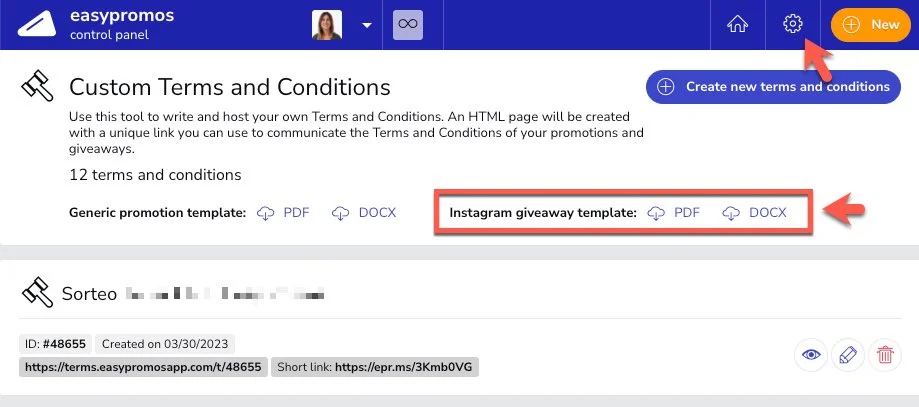
If you’re planning a promotion, these are the main clauses and considerations you should review.
Identify the Promotion Organizer
First, the terms and conditions should clearly identify the company or organization running the promotion. At a minimum, include:
- Company or legal name
- Registered business address
- Tax identification number or other applicable tax ID
- Email address or other contact method
Promotion Start and End Dates
Clearly state the date and time when the participation period begins and ends. These dates determine which entries are valid and which fall outside the participation period.
Promotion Mechanic and Participation Requirements
The terms and conditions should clearly explain what users need to do to participate and, where applicable, which actions allow them to earn additional entries.
For example:
“To participate, users must leave a comment on the specified Instagram post and follow the brand’s account. Participants may also receive one additional entry for each different friend they mention in the comments, up to a maximum of 10 additional entries.”
Winner Selection Date and Number of Winners
The terms and conditions should specify when the winners will be selected, how many winners there will be, and, where applicable, how many alternates will be selected. It is also good practice to explain the system that will be used to select the winners.
For example, if the random drawing is carried out with Easypromos, you can state:
“The random drawing will be conducted using the Easypromos platform, which uses its own random number generator (RNG) certified in accordance with the international GLI-19 v3.0 standard. Once the drawing has been completed, Easypromos will issue a public Certificate of Validity that verifies the randomness and transparency of the process and allows the drawing results to be consulted.”
Participation Validity
It is also advisable to specify the requirements an entry must meet to be considered valid and what will happen if a winner does not meet the conditions established in the terms and conditions.
For example, the organizer may reserve the right to request additional information from a winner to verify that they meet the participation requirements. If they do not, they may be replaced by an alternate winner.
The terms and conditions may also provide for the exclusion of entries submitted outside the promotional period, entries made using fake or duplicate accounts or automated systems, or any attempt to manipulate the promotion mechanic.
Planning a promotion across multiple countries? Download our free ebook Legal Aspects of International Promotions for practical guidance on the legal considerations to review when running an international campaign.
Participation Limitations
Additional restrictions can be established where appropriate for the promotion. For example, employees of the organizing company, employees of certain partner companies, or their immediate family members may be excluded from participating.
Any such limitations should be clearly described in the terms and conditions.
Prize Details
The terms and conditions should clearly describe the prize the winner will receive.
It is advisable to specify the prize, the number of units available, its approximate value, whether it can be exchanged for cash, whether it is transferable, how and when it will be delivered, and any other relevant conditions or restrictions associated with receiving or using it.
For example, if the prize is a trip, specify what is included and which expenses are not covered. If the prize is a product, you can include its model, main features, or approximate value.
Tax and Legal Requirements for Giveaways
In addition to describing the prize, you should determine whether the giveaway is subject to specific legal or tax obligations. These requirements vary depending on the country, and sometimes the state or region, where the promotion is run.
Below are two examples for reference.
Spain
In Spain, promotional giveaways commonly run on social media, where participation is free and the winner is selected at random, are generally considered “combinaciones aleatorias con fines publicitarios o promocionales” (random drawings for advertising or promotional purposes).
These promotions do not require authorization or prior notification to the Spanish Directorate General for the Regulation of Gambling, provided participation does not involve any surcharge or additional fee. They are, however, subject to tax obligations. As a general rule, organizers must pay a tax equivalent to 10% of the total market value of the prizes offered.
The prize also has tax implications for the winner. It is generally treated as a capital gain for Spanish personal income tax purposes. When the withholding base of an individual prize exceeds €300, the organizer must apply the corresponding withholding or payment on account. For non-cash prizes, the terms and conditions should clearly specify whether the organizer will bear the cost of this payment on account or pass it on to the winner.
For this reason, when offering a prize of significant value, it is advisable to clearly define its tax treatment in the terms and conditions and verify the obligations that apply in the relevant autonomous community.
United States
In the United States, the legal requirements for a promotional sweepstakes differ from those in Spain. A sweepstakes based on chance cannot require participants to make a purchase or payment to enter or to improve their chances of winning. State laws may impose additional requirements, including specific disclosures, registration, or bonding, so organizers should review the rules applicable in every state where the promotion is offered.
Prizes are also generally taxable income for the winner, including the fair market value of prizes awarded as goods or services. For payments made after December 31, 2025, the federal information-reporting threshold for prizes and awards reported on Form 1099-MISC is generally $2,000, although the applicable reporting and tax obligations should be reviewed for each promotion.
Because legal and tax requirements can vary significantly by jurisdiction, organizers running promotions across multiple countries or U.S. states should obtain appropriate legal or tax advice before launching the campaign.
Winner Notification
The terms and conditions should explain how and when the giveaway results will be announced and what the winner must do to accept or claim the prize.
For example, the organizer may contact the winner by direct message and subsequently publish the results on the relevant social network.
It is also advisable to specify how long the winner has to respond. If they do not respond within that period, the terms and conditions may establish that the prize will pass to an alternate winner.
The response period, number of alternates, and contact procedure should all be defined in advance.
To simplify winner management, it is advisable to use a system that securely collects the information required to deliver the prize. The Easypromos Claim Your Prize system allows organizers to create a dedicated form to collect this information and, where applicable, any additional authorizations or consent required from the winner.
Publishing Winners, Image Rights, and Intellectual Property
If the organizer plans to publish a winner’s name, username, image, or submitted content, the terms and conditions should clearly inform participants and, where necessary, establish the corresponding authorization or transfer of rights.
This is particularly important for photo, video, writing, or other user-generated content contests. In these cases, the terms and conditions should explain what usage rights the organizer requires, for what purpose, for how long, and across which channels or media.
Participant Posts and Comments
If the promotion requires participants to submit comments, photos, videos, or other content, the terms and conditions may specify which types of content are not permitted.
For example, the organizer may exclude content that is offensive, discriminatory, unlawful, infringes the rights of third parties, or violates the rules of the social network where the promotion takes place.
The terms and conditions may also establish that such content can be removed and that the participant may be disqualified from the promotion where appropriate.
Extensions, Suspensions, or Cancellations
It is advisable to establish what will happen if the promotion needs to be extended, suspended, or canceled due to force majeure, serious technical issues, or other circumstances that prevent it from proceeding as planned.
Any significant changes should be communicated to participants transparently.
Disqualifications and Penalties
The terms and conditions may establish that participants who violate the rules or act fraudulently can be disqualified.
For example, fraudulent behavior may include using multiple accounts, false identities, unauthorized automated systems, or any other form of manipulation intended to give a participant an unfair advantage over others.
Organizer Liability
The terms and conditions may include a clause that reasonably defines the organizer’s liability in cases where participants fail to comply with the rules or a winner makes improper use of the prize.
However, this clause should not be used to exclude any liability that legally rests with the organizer.
Personal Data Protection
A social media promotion involves the processing of personal data whenever information that can identify participants is collected. For example, in a comment-based giveaway, the organizer will process at least the participant’s username and, depending on the information provided by the platform, may also process their profile picture.
Participants should therefore receive clear information about how their personal data will be processed. This information can be included in a privacy clause within the promotion terms and conditions.
For example, in a comment-based giveaway, the privacy clause should explain that the participant’s username and, where applicable, profile picture will be used to manage participation, select the winner, and publicly announce the giveaway results.
It is also advisable to specify how long the winner list or Winners Page will remain publicly accessible and what will subsequently happen to this data. If the data obtained through the social network will not be used for any other purpose, this should be stated explicitly. For example, you can specify that it will not be used to send marketing communications or added to other databases.
If the promotion also includes a registration form, the terms and conditions should explain how the data collected through that form will be processed. For example, if an email address is requested, they should distinguish clearly between its use to manage the promotion and any additional purpose, such as sending marketing communications.
The privacy clause should also identify the data controller, the applicable legal basis for processing, the data retention periods or criteria, any recipients or transfers where applicable, and how participants can exercise their data protection rights, including:
- Access
- Rectification
- Erasure
- Objection
- Restriction of processing
- Data portability, where applicable
- The right not to be subject to certain automated decisions, where applicable
Social Media Platform Rules
In addition to complying with applicable laws and the promotion’s own terms and conditions, promotions run on Instagram, Facebook, X, or other social networks must comply with the specific rules of each platform.
These rules may establish requirements regarding how promotions are organized, permitted content, certain participation mechanics, or the disclosures that must be included.
For example, Instagram requires promotions to include a release of Instagram and an acknowledgment that the promotion is not sponsored, endorsed, administered by, or associated with Instagram.
Always review the current rules of the social network where you plan to run the promotion before launching it.
Contact and Complaints
The terms and conditions should provide a contact channel that participants can use to ask questions or submit complaints related to the promotion.
In most cases, this will be an email address managed by the organizer.
Acceptance of the Terms and Conditions
Participation in the promotion implies acceptance of the terms and conditions.
Before publishing a giveaway or contest on social media, make sure the terms are easy for participants to access before and during participation. For example, you can link to them from your Instagram bio, share them in a Story with a link, include access from the promotional post, or host them on a dedicated page of your website.
Applicable Law and Jurisdiction
The terms and conditions should identify the applicable law and, where appropriate, the competent jurisdiction for resolving disputes.
For promotions aimed at consumers, this clause must respect mandatory consumer protection rules and should not restrict rights that participants are legally entitled to.
If the promotion is open to participants in multiple countries or territories, this point should be reviewed carefully for each relevant jurisdiction.
Practical Recommendation
Terms and conditions should always be adapted to the specific mechanic and scope of each promotion. A template can provide a useful starting point, but particular attention should be paid to the territory, prizes, taxation, personal data processing, and the rules of the social network being used.
For more complex promotions, high-value prizes, or campaigns running across several countries, it is advisable to seek specific legal advice before launch.