Memory games are one of the most popular branded mini-games because they combine entertainment, product exposure, and active participation in a format that is easy to understand and accessible to a wide audience.
With Easypromos, you can create a branded Memory game without coding, customize the design, enable leaderboards, collect participant data, and publish the game as a microsite or embed it on your website.
In this guide, we explain how branded Memory games work, why marketers use them, how to create one, and real examples of successful campaigns.
What Is a Branded Memory Game?
Memory games combine entertainment and active participation, making them an effective format for increasing engagement and brand exposure. Unlike passive advertising formats, participants must interact with branded content while completing the challenge.
Brands use Memory games for product launches, lead generation, employee engagement, event activations, tourism promotion, and loyalty campaigns. The mechanic also reinforces visual recognition by repeatedly exposing participants to products, logos, destinations, characters, or campaign imagery.
Because the game is simple and accessible, it can be adapted to a wide variety of audiences and marketing objectives.
Why Brands Use Memory Games in Marketing Campaigns
Memory games are one of the most versatile branded mini-games because they combine entertainment, visual recognition, and active participation in a simple format that works across many industries and campaign types.
Some of the main reasons brands use Memory games include:
- Adaptable to different marketing objectives: Use them for product launches, lead generation, employee engagement, event activations, tourism promotion, customer loyalty, or awareness campaigns.
- Strong visual recognition: Participants repeatedly interact with product images, logos, destinations, characters, and campaign visuals while playing, increasing familiarity with the content.
- Simple and accessible gameplay: The rules are easy to understand and require no previous experience, making the game suitable for a wide range of audiences.
- High engagement potential: Unlike passive advertising formats, participants actively interact with branded content while completing the challenge.
- Flexible participation models: Campaigns can include leaderboards, prize drawings, registration forms, audience segmentation questions, or instant rewards depending on the objective.
- Suitable for many industries: Brands, tourism organizations, educational institutions, event organizers, and employers can all adapt the mechanic to their specific goals.
Because of this flexibility, Memory games can be used in campaigns ranging from product launches and trade fair activations to employee engagement programs and destination marketing initiatives.
How an Online Memory Game Works
In a Memory game, participants flip two cards at a time and try to find matching pairs. When two matching cards are revealed, they remain visible. If the cards do not match, they are turned face down again, and the participant must remember their location for future attempts.
The challenge continues until all pairs have been found. Each game includes a configurable time limit, while the difficulty level can be adjusted by increasing or reducing the number of matching pairs. Scores can be used to rank participants on a leaderboard.
Brands can customize the images displayed on the cards to showcase products, campaign visuals, destinations, sponsors, characters, or other branded content. This transforms a classic game mechanic into an interactive marketing experience.
A typical branded Memory game campaign follows a simple participation flow:
- The participant accesses the game microsite.
- They register before or after playing, depending on the campaign setup.
- They complete the Memory challenge.
- Their score is recorded on a leaderboard or submitted as an entry into a prize draw.
- Winners are selected based on ranking, score, or a random draw among eligible participants.
Branded Memory Game Examples and Ideas
One of the strengths of a branded Memory game is its flexibility. The same game mechanic can be adapted to different audiences, industries, and campaign formats.
The examples below show how brands and organizations have customized Memory games to promote products, engage audiences, support events, and create competitive experiences.
Tourism and Destination Marketing Memory Games
Memory games can be used to promote destinations, attractions, events, and tourism experiences. By replacing traditional card designs with images related to a region, destination, or campaign, organizations can create an entertaining way for participants to discover and remember key visual elements.
Turismo Ambroz used a branded Memory game to promote the Valle del Ambroz and surrounding destinations. The campaign was shared primarily through Facebook and Instagram, where participants were invited to complete the challenge for the chance to win accommodation stays in the region.
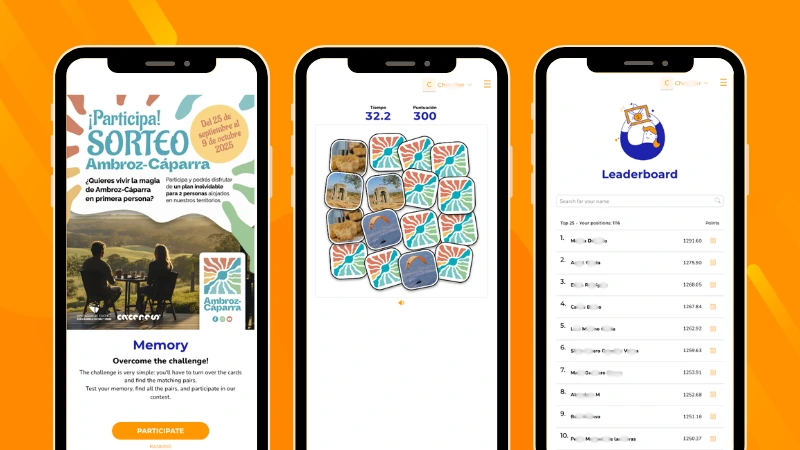
The campaign generated 1,548 participants and 8,647 game plays in just two weeks. Winners were selected through a random prize drawing among all participants who completed the game, with accommodation stays awarded as prizes.
A similar approach was used by TGV INOUI and SNCF Voyageurs to promote travel to Paris. Participants completed a Memory game featuring images of Parisian destinations and attractions for the chance to win train tickets to Paris and French product gift baskets. The campaign attracted more than 700 participants in less than three days.
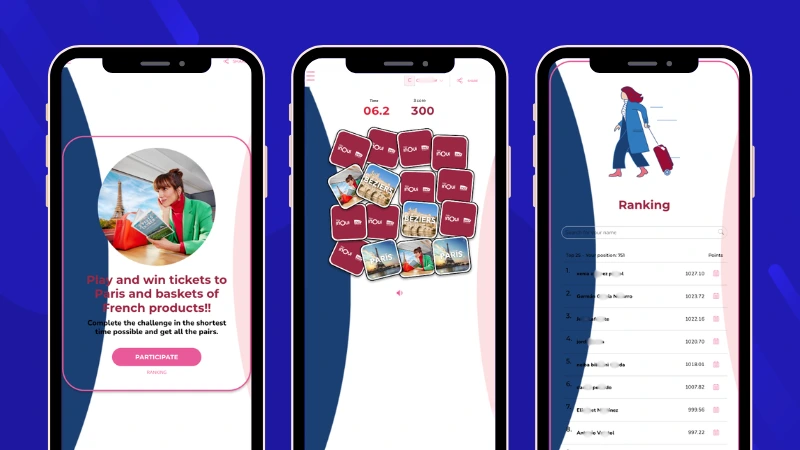
These examples show how tourism organizations, destinations, and travel brands can use Memory games to combine destination discovery, social media promotion, and prize incentives in a single interactive campaign.
Product Recognition Memory Games
Memory games are particularly effective for product awareness campaigns because participants repeatedly interact with product images while trying to complete the challenge. Instead of passively viewing an advertisement, they actively engage with the products throughout the game.
A good example comes from skincare brand CeraVe, which launched a Memory game at its trade fair booth using images of its products as the matching pairs. Visitors played the game anonymously, with no registration required, making participation quick and frictionless.
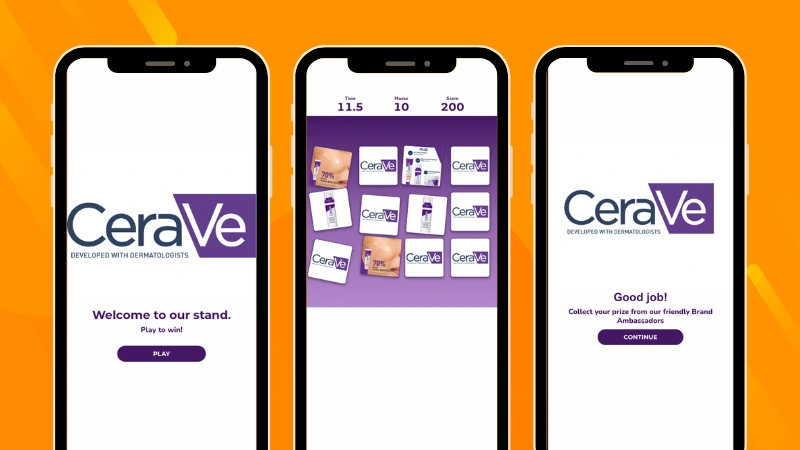
As participants searched for matching pairs, they became more familiar with the products featured on the cards. In just seven days, the game generated more than 1,000 participations, helping CeraVe attract visitors to its stand and increase product visibility during the event.
Product Launch Memory Games
Memory games can be an effective way to introduce new products, collections, flavors, or product variations. Instead of simply showing promotional images, brands can encourage participants to actively discover and recognize products while completing the challenge.
Vape brand Lost Mary used a branded Memory game to promote the flavors of its MT15000 Turbo Weekly Edition. Each matching pair featured a different flavor variant, turning the game into an interactive product discovery experience.
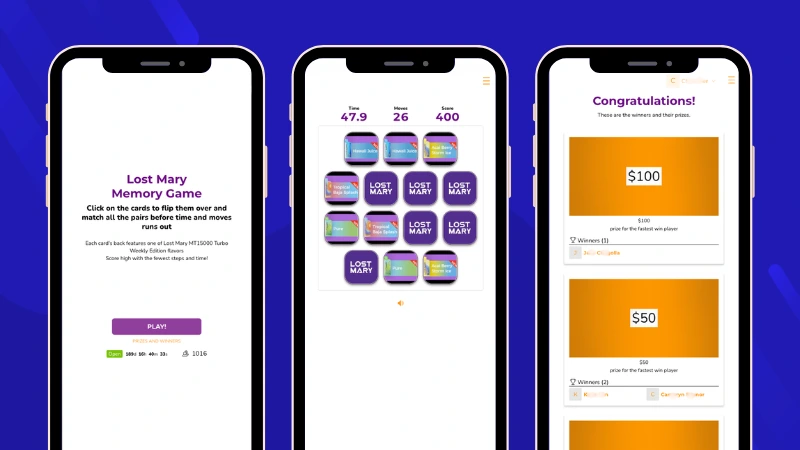
Participants competed to achieve the best score with the fewest moves and shortest completion time. A public leaderboard added a competitive element, while prizes rewarded the top-performing players. The campaign generated 795 game plays and awarded 13 prizes, including cash rewards for the highest-ranking participants.
By incorporating product images directly into the gameplay, brands can increase familiarity with new products while creating a more engaging experience than traditional launch communications. The same strategy can be applied to seasonal collections, limited editions, and other product launch campaigns.
Educational and Employee Engagement Memory Games
Memory games can be used to reinforce knowledge, improve information recall, and increase participation in training and awareness initiatives. By combining learning objectives with a familiar game mechanic, organizations can encourage employees to engage with content in a more active and enjoyable way.
A good example is the Lightning Match AI Memory Challenge launched by Penumbra during Cybersecurity Awareness Month. The campaign was designed for employees and combined a Memory game with a public leaderboard, encouraging participants to improve their scores and return to play multiple times throughout the campaign.
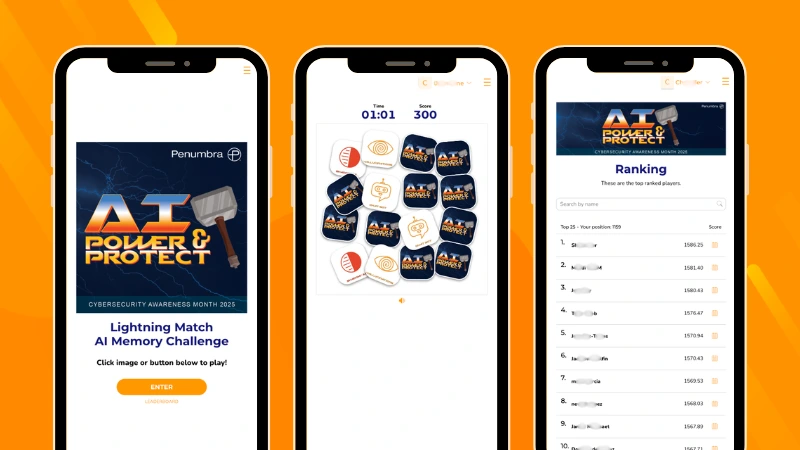
The challenge generated 1,235 participants and more than 22,890 game plays, demonstrating the strong replay potential of leaderboard-based Memory games. Participants competed to achieve the best scores while reinforcing cybersecurity-related concepts and maintaining engagement throughout the awareness initiative.
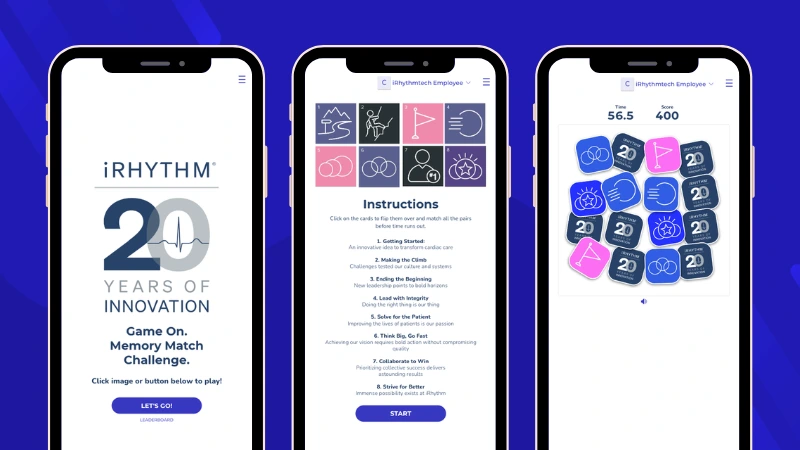
The same mechanic can also be used for company culture and internal communications initiatives. For example, iRhythm Technologies launched a Memory game exclusively for employees as part of its “20 Years of Innovation” campaign. The cards featured milestones, company values, and key moments from the organization’s history, helping employees engage with the anniversary celebration while reinforcing corporate culture through gameplay.
Prize Drawing Memory Games
While some Memory games use leaderboards to encourage competition, many campaigns rely on a prize drawing instead. In these cases, participants are rewarded for completing the challenge rather than achieving the highest score.
Participants complete the Memory game and are then entered into a prize drawing for the chance to win a reward. Prizes can include products, gift cards, event tickets, experiences, vouchers, or other incentives relevant to the target audience.
As with other Easypromos promotions, prize drawings can be managed directly from the platform. Winners are selected in just a few steps using the built-in random winner selection tool, and the results can be published on a winners page linked to the campaign so participants can verify the outcome.
SIGAUS used a branded Memory game to promote its urban forest initiative and raise awareness about environmental sustainability. Participants matched cards featuring information about the SIGAUS forests and, after completing the challenge, became eligible for different types of rewards.
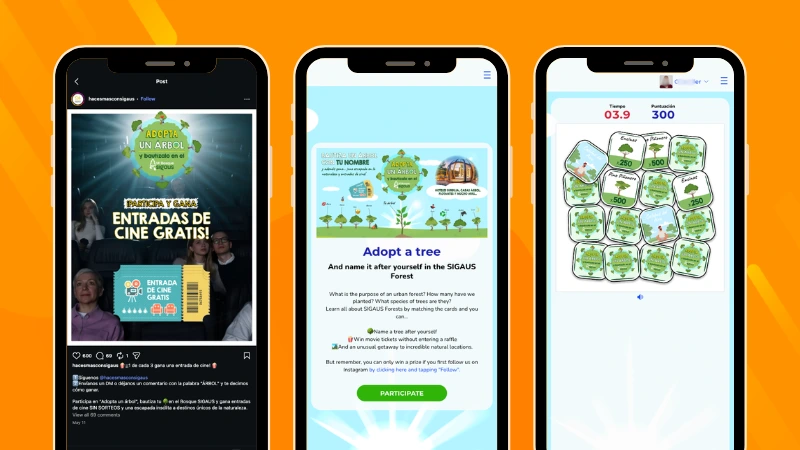
The campaign combined multiple incentive models. Participants could instantly win the opportunity to name a tree in the SIGAUS urban forest, receive cinema tickets through Instant Win prizes, or enter a prize drawing for a nature getaway experience.
To participate, users were encouraged to follow the organization on Instagram, showing how Memory games can be combined with social media actions, Instant Win rewards, and prize drawings in a single campaign.
This model prioritizes participation over performance, making it suitable for campaigns targeting broad audiences. Rather than rewarding only the highest scores, brands can use prize drawings, Instant Win rewards, or both to encourage participation.
Leaderboard-Based Memory Challenges
Adding a leaderboard transforms a simple Memory game into an ongoing competition. Instead of participating just once, players are motivated to return, improve their scores, and climb the rankings throughout the campaign.
Western Digital used this approach in a Christmas promotion in Japan. Participants played a branded Memory game featuring the company’s products and competed for a place at the top of the leaderboard. The campaign awarded four high-capacity external hard drives to the highest-ranking players.
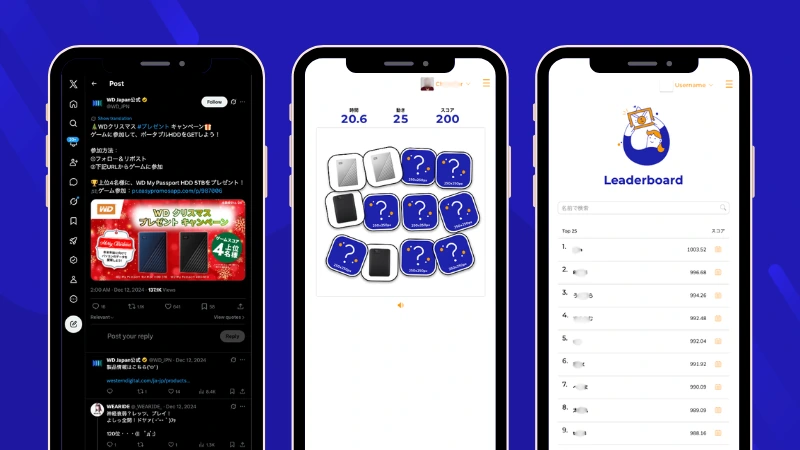
To encourage participation, Western Digital promoted the campaign through X (formerly Twitter), where users followed the brand account, reposted the campaign post, and registered to play the game. Nearly 700 of the campaign’s 786 participants came from X, demonstrating how Memory games can be combined with social media promotion to increase reach.
The campaign generated 8,982 game plays, highlighting the strong replay value of competitive Memory challenges. By rewarding top-performing participants, brands can encourage repeat visits, increase engagement, and create a stronger sense of competition throughout the campaign period.
Leaderboard-based Memory games are particularly effective for product promotions, seasonal campaigns, community engagement initiatives, and other campaigns where repeat participation is an important objective.
How to Create a Branded Memory Game Step by Step
- Define the Campaign Goal
Start by identifying what you want to achieve. Memory games can support product launches, lead generation, employee engagement, event participation, destination promotion, and loyalty campaigns. Your objective will determine whether you use a leaderboard, collect participant data, award prizes, or run a prize drawing.
- Choose the Images and Customize the Game Design
Select images that support your campaign objective and are easy for participants to recognize. Depending on the campaign, these may include product photos, packaging designs, destinations, logos, characters, campaign visuals, or educational content. You can also customize the card backs, colors, backgrounds, typography, and other visual elements to match your brand identity and create a consistent participant experience.
- Adjust the Difficulty Level
Configure the number of card pairs and the game time limit based on your audience and campaign goals. Simple challenges work well for participation-focused campaigns, while more competitive campaigns can use larger boards, shorter time limits, and leaderboards.
- Add Registration and Data Collection
Decide whether participants should register before or after playing. Registration forms can be used to collect participant data, obtain consent, and qualify entries. Only request the information needed for the campaign.
- Configure the Terms and Conditions
If your campaign collects participant data or awards prizes, make sure the terms and conditions comply with the regulations applicable in your market. Depending on the country, you may need to include specific consent checkboxes, privacy notices, or legal information related to data protection regulations such as the GDPR in Europe.
- Configure Leaderboards, Prizes, or Prize Drawings
Choose how participants will be rewarded. Some campaigns reward the highest-ranking players through a leaderboard, while others enter all eligible participants into a random prize drawing. You can also combine multiple reward models, such as leaderboards, prize drawings, and Instant Win prizes within the same campaign.
- Publish and Launch the Campaign
Once your Memory game is ready, publish it as a standalone microsite with its own URL or embed it on your website. You can then promote the campaign through social media, email marketing, QR codes, paid advertising, or any other communication channel relevant to your audience.
Discover a complete Memory game campaign. Play our Sunshop Memory game and experience the full participant journey. The game challenges participants to match products from the brand’s latest eyewear collection, demonstrating how Memory games can transform product discovery into an engaging interactive experience while increasing exposure to key products and new releases.
Branded Memory Game FAQs
Can I customize the Memory game with my own brand design and images?
Yes. You can fully customize the Memory game using your own images, including product photos, packaging designs, logos, campaign visuals, destinations, characters, sponsors, or other branded assets. You can also customize the card backs, colors, backgrounds, typography, and other visual elements to create a game that matches your brand identity and campaign design.
Can I add a registration form to collect participant data?
Yes. You can include a registration form before or after the game to collect participant information, obtain consent, qualify entries, or build a database for future marketing campaigns.
Can I use a leaderboard in a Memory game?
Yes. You can enable a public leaderboard that ranks participants based on their score, completion time, or other criteria. Leaderboards are particularly effective for encouraging repeat participation and competition.
Can I award prizes to participants?
Yes. You can reward participants in different ways, including prizes for the highest-ranking players, random prize drawings among all eligible participants, or a combination of both approaches.
Can I control the difficulty level of the game?
Yes. You can adjust the number of card pairs, the game duration, and other settings to create a simpler or more challenging experience depending on your audience and campaign goals.
Can I publish the Memory game on my website?
Yes. Memory games can be published as standalone microsites with their own URL or embedded directly into your website, making them easy to share through social media, email campaigns, QR codes, and other channels.
How long does it take to create a branded Memory game?
Most branded Memory games can be created in less than an hour. Once you have prepared the images and campaign assets, the setup process is straightforward and does not require coding skills.
Conclusion
Branded Memory games can support many different campaign objectives, from product launches and destination marketing to employee engagement, awareness campaigns, and lead generation. The examples in this article show how a simple card-matching challenge can be adapted to different audiences, industries, and participation models.
With Easypromos, brands can create and manage branded Memory game campaigns with registration forms, leaderboards, prize drawings, Instant Win rewards, and fully customizable designs from a single platform.
Have a specific campaign in mind? Contact us via live chat or request a video call to discuss your goals. We’ll be happy to review your use case and help you adapt a Memory game to your audience, channels, and objectives.