There are two main ways to run a social media contest. You can organize it directly on platforms like Instagram, Facebook, or X, or you can create a standalone online contest hosted on a microsite and promote it through social media. The best option depends on your objectives, the level of control you need, and the type of interaction you want to generate.
As a digital engagement platform, Easypromos allows you to design, publish, and manage social media contests with full control over participation, data collection, and winner selection.
In this guide, we explain how to create a social media contest step by step, including formats, ideas, and best practices to ensure your campaign delivers results.
Types of Social Media Contests (and How to Choose the Right One)
Before launching a social media contest, it’s important to define your objective and choose the format that best supports it. Not all contests work the same way, and the structure you choose will determine how users participate and what results you achieve.
In practice, there are two main types of social media contests:
1. Social media giveaways (native contests)
These types of contests take place directly on platforms like Instagram, Facebook, or X. Participation is usually simple, such as liking a post, commenting, following the account, or tagging friends.
These formats are also commonly referred to as social media giveaways, as participation is based on simple actions and prizes are typically awarded at random, without depending on skill or merit.
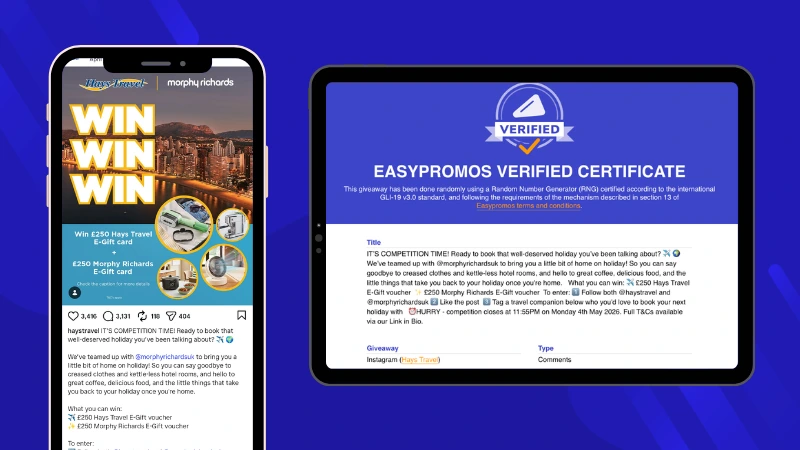
For example, travel agency Hays Travel launched an Instagram Giveaway where users participated by commenting on the post and following the account for the chance to win a prize. This type of mechanic is designed to maximize visibility, reach, and engagement with minimal participation friction.
This format is best when you want to:
- increase visibility and reach
- grow your follower base
- generate quick engagement
2. Microsite-based contests (hosted campaigns)
These contests are hosted on a dedicated landing page and promoted through social media. Users access the campaign via a link and complete actions such as submitting content, filling out a form, or voting.
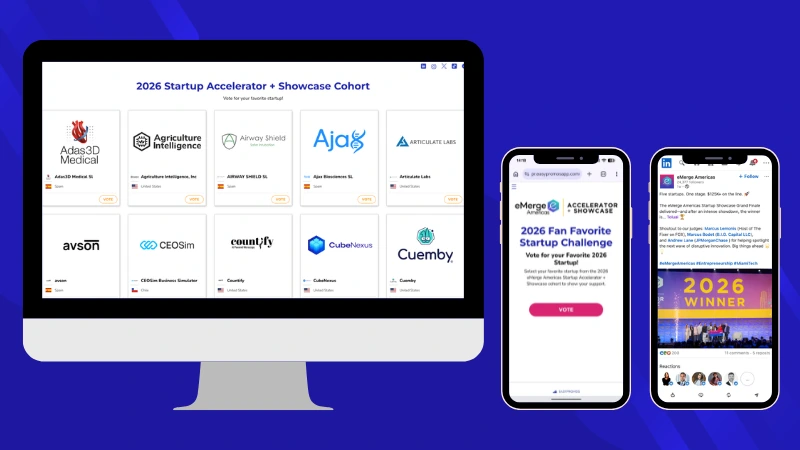
For example, eMerge Americas launched the 2026 Fan Favorite Startup Challenge, where startups participated through a dedicated contest microsite and audiences voted for their favorite projects. The campaign was promoted through social media channels, while participation and voting were managed within a controlled environment.
This type of hosted contest is especially effective when you need to organize submissions, manage public voting, and maintain full control over participation rules and validation.
This format is ideal when you want to:
- collect user data (zero-party data)
- gather user-generated content (UGC)
- run more advanced mechanics such as voting or galleries
- maintain full control over the campaign
Planning to run your contest on Instagram? Read our step-by-step guide on How to Run an Instagram Contest
First steps to create a social media contest
To create a successful social media contest, you need to start with a clear objective and choose the right format to support it. This will define how users participate and what results you can expect from the campaign.
Key first steps to creating a social media contest
- Define your objective
Start by identifying your primary goal. Are you looking to increase visibility, generate user-generated content (UGC), collect user data, or drive conversions? Each objective requires a different contest structure.
- Choose the contest type
Select the format based on your objective and the level of control you need. Social media giveaways are effective for reach and engagement, while microsite-based contests allow you to collect data, manage participation, and run more advanced mechanics.
- Define the participation flow
Decide how users will move from social media to participation. This includes how they discover the contest, how they access it, and what actions they need to complete. Reducing friction at this stage is key to maximizing participation.
- Select the incentive
Choose a prize or incentive that is relevant to your audience and aligned with your brand. A well-matched incentive improves both participation rate and the quality of the audience you attract.
By structuring your contest around these elements, you can create a campaign that is both engaging for users and effective in achieving your marketing goals.
What is a social media contest platform?
A social media contest platform is a tool that allows brands to create, manage, and optimize interactive campaigns across social networks and dedicated landing pages.
Instead of relying only on native platform features, these solutions provide additional capabilities such as registration forms, content galleries, voting systems with fraud control, and secure winner selection.
Using a social media contest platform is especially important when you need to:
- collect user data in a structured and compliant way
- manage large volumes of participants
- run advanced mechanics such as voting or multi-stage contests
- maintain full control over participation and results
As a digital engagement platform, Easypromos allows you to design and manage social media contests from a single platform, combining social media reach with structured participation, data capture, and campaign control.
Want to go further? Download our free ebook The role of contests in a marketing strategy and discover how brands use contests to increase visibility, generate UGC, capture leads, and build stronger audience engagement.
Social media contest ideas to generate UGC and increase reach
One of the main advantages of social media contests is their ability to generate user-generated content (UGC) while increasing visibility and participation.
If your goal goes beyond simple engagement, you can use contest formats that encourage users to create and share content as part of the experience.
Below are several proven social media contest ideas that can be adapted to different campaign goals.
1. Photo or video contests with gallery (microsite UGC)
In this format, users access a dedicated campaign page where they upload their content, which is then displayed in a public gallery.
With Easypromos, you can create contests where users upload photos, videos, or design submissions, enable voting, and moderate entries to ensure quality and relevance.
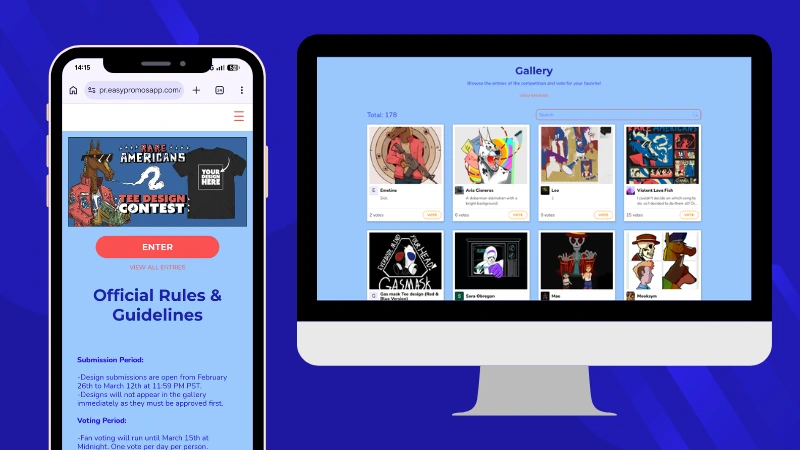
For example, the band Rare Americans organized a t-shirt design contest where fans submitted original artwork inspired by the album Rare Americans 2. Entries were uploaded through a dedicated microsite, reviewed before publication, and displayed in a public gallery where users could vote for their favorite designs.
This type of contest is especially effective when you want to combine user-generated content, community participation, and public voting within a controlled environment.
2. Mention + hashtag contests (social media UGC)
In this format, users participate by publishing content on their own social media profiles and tagging your brand or using a campaign hashtag.
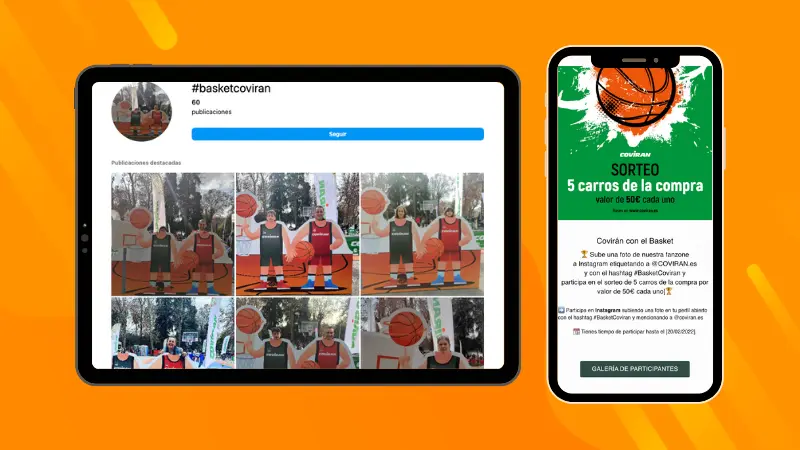
For example, the professional basketball team Girona Basket launched a photo contest where participants shared images from the fan zone and mentioned the team’s sponsor. This approach increases visibility and reach while encouraging content creation.
3. Writing contests (qualitative UGC + engagement)
Writing contests are effective when you want to generate more meaningful or emotional engagement. Instead of images or videos, users submit short texts, opinions, or stories.
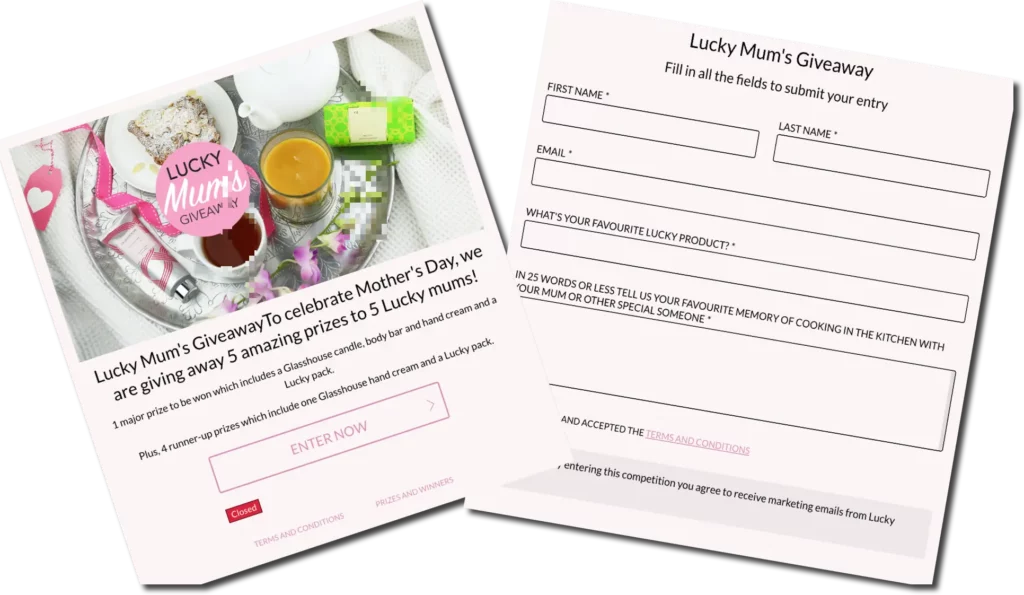
For example, Lucky Nuts organized a Mother’s Day writing contest where users shared personal stories and indicated their favorite product. This generated emotional engagement while also providing valuable insights into customer preferences.
4. Travel contests (aspirational engagement)
Travel contests are especially effective for generating aspirational content and high engagement. By offering experience-based prizes or showcasing memorable experiences, brands can motivate users to create and share meaningful content.
To run a travel contest effectively:
- define a clear theme related to destinations, experiences, or travel memories
- choose a format such as photo, video, or storytelling submissions
- encourage participants to share their entry to increase visibility and engagement
- offer a prize that aligns with the experience and audience you want to attract
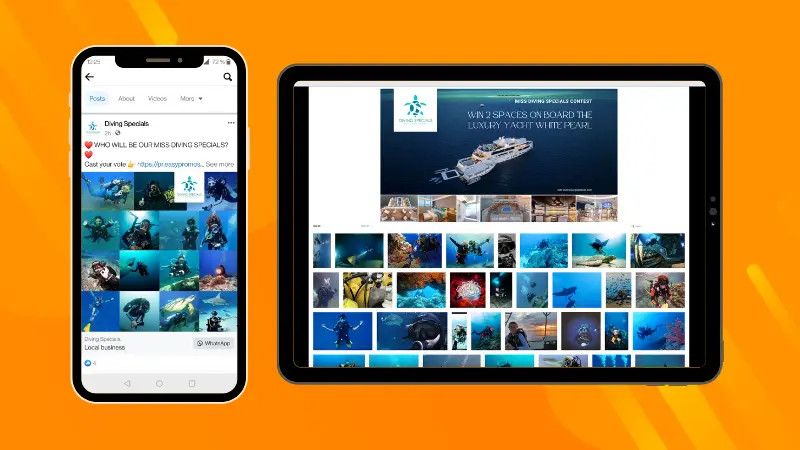
For example, a scuba diving company organized a travel photo contest where participants submitted images from their diving experiences. Winners were selected through public voting, encouraging participants to share their entries and attract votes, which helped increase the campaign’s reach organically.
When to use these formats
These types of contests are best when you want to:
- build a content library for future marketing use
- generate high-quality user-generated content
- increase visibility through participant sharing
- encourage active participation and interaction
Social media contests to collect user data and generate leads
If your priority is to build a structured database and manage user data beyond social media interactions, you need a contest format that allows you to control the registration process and capture information directly.
Microsite-based contests are the most effective approach for this. Participants access a dedicated campaign page where they complete a registration form before or after participating. This allows you to collect zero-party data such as contact details, preferences, or other relevant information.
It also allows you to comply with data protection regulations by requesting explicit consent from users for data processing, as well as permission to use images or videos when applicable.
Lead capture with entry forms
One of the simplest ways to collect user data is through Entry Form Giveaways. Users register for a chance to win a prize, providing their contact details as part of the process.
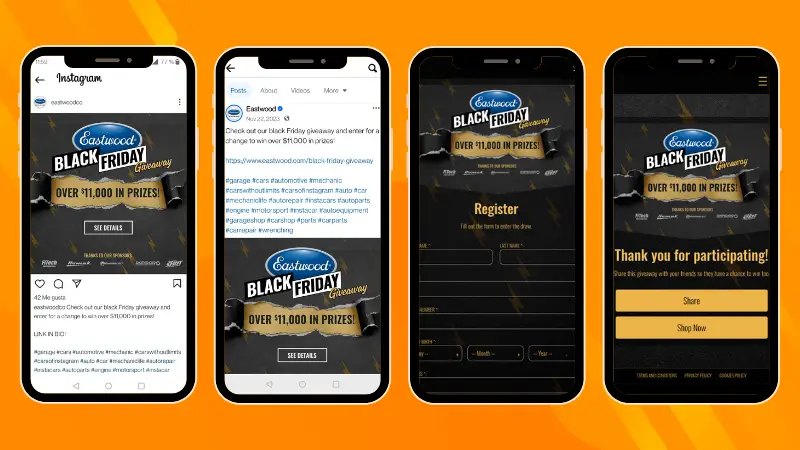
For example, the car restoration supplies company Eastwood promoted a Black Friday giveaway on social media and directed users to a registration page where they entered their details for the chance to win over $10,000 in prizes. This approach combines social media reach with structured lead capture.
Collecting qualitative data through participation
Beyond basic contact details, contests can also help you collect qualitative data: opinions, preferences, motivations, stories, or personal experiences shared directly by participants.
This type of information is especially valuable when you want to better understand your audience, identify interests, or gather insights that can improve future campaigns and communication.
One of the most effective formats for collecting qualitative data is a writing or recipe contest. For example, participants can be asked to share a recipe, explain how they use a product, describe a personal experience, or answer an open-ended question related to the campaign.
In our Recipe Contest demo, participants submit their own recipes along with images and descriptions. This type of contest not only generates user-generated content, but also provides valuable insights into customer preferences, habits, and product usage.
With Easypromos, you can configure fully customizable registration forms and combine them with different participation mechanics, ensuring that data collection is structured, compliant, and directly usable in your marketing workflows.
When to use this approach
This type of contest is best when you want to:
- connect your contest data with your CRM or marketing tools
- build a qualified database for future campaigns
- collect both quantitative and qualitative user data
- segment users based on interests or preferences
- maintain full control over participation and validation
How to reduce participation barriers in a social media contest
The success of a social media contest depends not only on the idea, but also on how easy it is for your audience to participate.
Different formats attract different types of users. For example, a video contest may generate high-quality content but typically requires more effort, while a simple Instagram giveaway (such as “comment and tag a friend”) can generate a much higher volume of participation.
When designing your contest, it’s important to align the participation requirements with your target audience. If the entry process is too complex or time-consuming, participation will drop significantly.
For example, asking users to record and edit a video may work for a niche or highly engaged audience, but it can be a barrier for a broader audience. In those cases, a simpler mechanic, such as submitting a photo or completing a short form, will lead to better results.
How to reduce participation friction
To maximize results:
- Adapt the contest format to your audience’s habits and capabilities
- Keep participation requirements clear and easy to understand
- Avoid unnecessary restrictions that may discourage users
- Limit the number of steps required to participate
A well-designed participation flow ensures that users not only discover your contest, but also complete the process.
How to pick a winner for a social media contest
Choosing how to select a winner is a key part of your contest design, as it directly impacts both participation and perceived fairness.
There are three common methods:
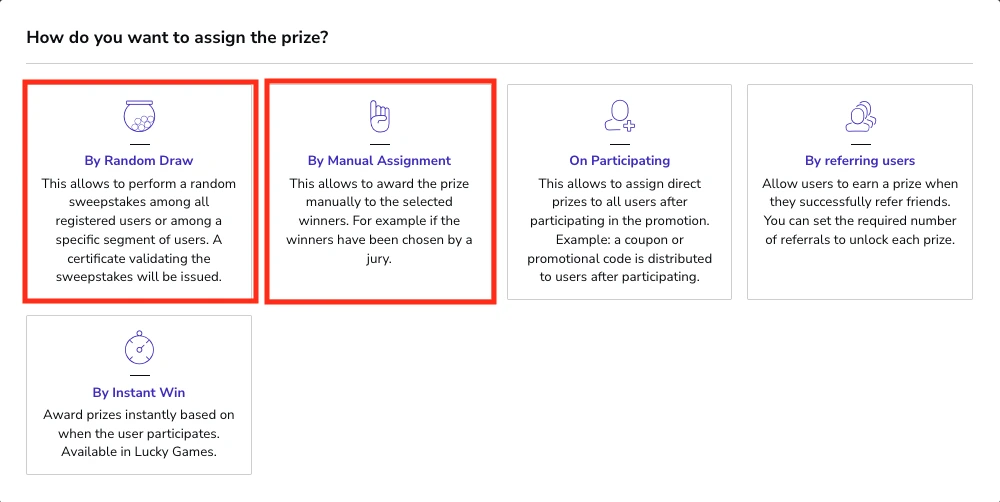
- Jury selection (Manual Assignment)
Best when quality matters more than quantity. A panel selects the winner based on predefined criteria. - Random drawing
Ideal for giveaways or contests focused on participation. It is simple, transparent, and encourages more users to enter. - Public voting (Manual Assignment)
Useful when you want to increase engagement and reach. Participants promote their entry to get votes, which helps expand the campaign.
Combining methods for better results
In many cases, combining methods works best. For example, you can use public voting to select finalists and then choose the final winner through a jury or a random drawing.
This approach allows you to balance engagement with control and ensures a fair and transparent outcome. It also helps prevent fraudulent behavior, as the prize is not awarded directly to the most-voted entry.
Easypromos allows you to manage these options from a single platform, including vote validation systems and secure random winner selection.
Ready to create your social media contest?
A well-designed social media contest combines the right format, clear participation mechanics, and a structured way to manage data and results.
By combining social media visibility with structured participation and data capture, you can turn individual campaigns into a consistent system for engagement, lead generation, and growth.
Easypromos allows you to create, publish, and manage your campaigns with full control over participation, data collection, and winner selection—all from a single platform.
If you’re planning your next contest, you can start by creating your account and testing different formats before launching your campaign. You can also reach out via live chat if you need help defining your approach.