Key Takeaways
- Automating key interactions helps scale engagement without increasing manual workload.
- Instagram DMs are a high-intent channel where users actively start private conversations with brands.
- Unlike public comments, DMs signal direct interest in products, promotions, or support.
- Many brands manage DMs reactively, missing opportunities to guide and convert users.
- Structuring conversations improves response time, user experience, and conversion potential.
You publish content on Instagram. You track reach, impressions, likes, and comments. You reply to Direct Messages when you can. For many brands, that’s where the Instagram strategy ends.
But Instagram is no longer just a visibility channel. Instagram DMs for business have become a direct communication channel where users ask questions, request information, and signal buying intent. According to Meta, more than 150 million people send Direct Messages to businesses every month. Your audience is not only consuming content. They are starting conversations that often signal active interest in your products, services, or campaigns. If you treat DMs as an inbox to check occasionally, you may be overlooking conversations that could move users closer to becoming clients.
When someone sends you a Direct Message asking about pricing, availability, delivery, or a promotion, that is not casual engagement. It is interest. Every Direct Message is a signal of intent. The question is whether you are capturing it.
What Are Instagram Direct Messages and How Do They Work for Businesses?
Instagram Direct Messages (DMs) are private messages sent through Instagram’s built-in messaging feature. They allow users to contact your brand directly inside the app.
As a business, you cannot initiate a private message unless the user interacts with you first. A DM conversation typically starts when someone:
- Taps the “Message” button on your profile
- Replies to one of your Stories
- Mentions your brand in their Story
The visual example below illustrates how the conversation appears in your inbox, which is divided into Primary, General, and Requests. Messages in Requests may remain unseen if they are not reviewed regularly. It also shows the manual organization options available, including moving conversations between tabs, adding labels by long-pressing a message, and applying filters to retrieve specific DMs.
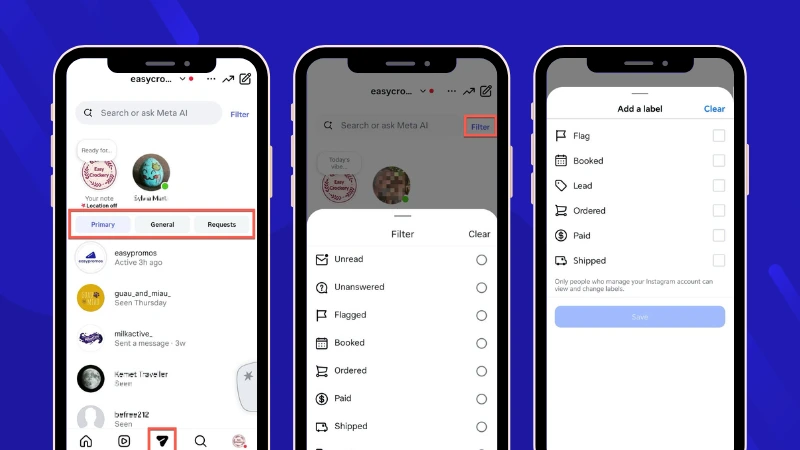
Not every interaction creates a DM. Story polls, quizzes, and sliders generate engagement data but do not open a conversation. A Story reply with text does. A DM creates a one-to-one conversation that is not visible to other users. It is often tied to the specific post or Story the user just saw. That context helps you understand what triggered the message. This is why DMs matter. When a message follows a specific post or Story, you can see exactly what triggered the interest.
Are Instagram Comments or Direct Messages More Effective for Business Growth?
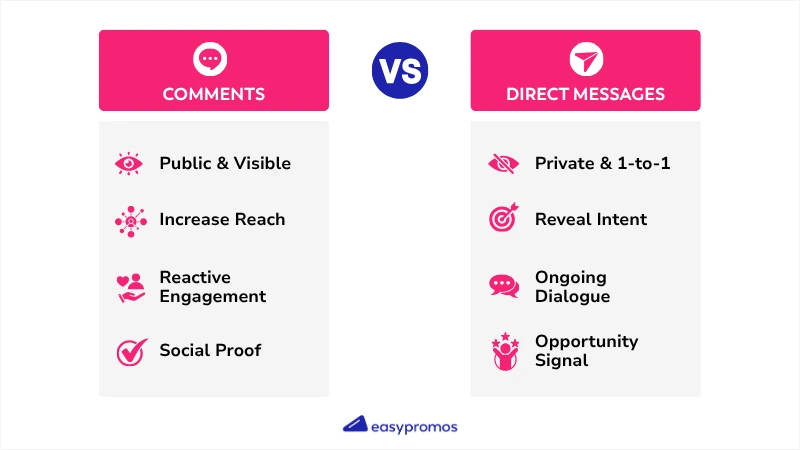
Both comments and Direct Messages support growth, but they serve different roles. Comments appear under posts and Reels. They are public. They increase visibility and social proof because other users can see them and the platform registers activity around your content. Many brands encourage comments during giveaways or campaigns to amplify reach. However, comments are usually brief. A tag, an emoji, or a short reaction does not always signal buying intent.
In contrast, Direct Messages are private. Only the brand and the user can see them. This privacy also provides clearer signals about who the user is and why they are reaching out, making it easier to start a more relevant and higher-quality conversation.
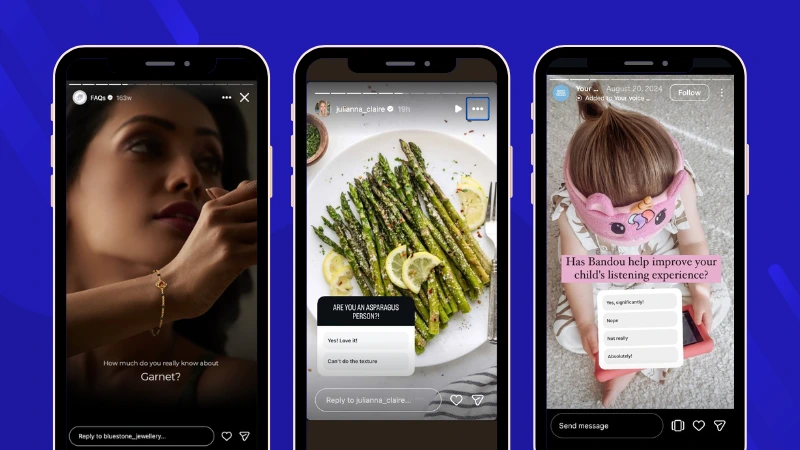
Stories sit between public engagement and private conversation. A poll or slider increases interaction, but a text reply opens a Direct Message thread. That is where the dynamic changes. Questions in Stories encourage users to send a written response. That response creates a DM conversation with the brand. In contrast, polls or sliders like the examples shown below increase engagement and connection, but they do not generate a direct message thread.
Inside a DM, users ask more specific questions:
- Is this available in my size?
- Do you ship internationally?
- How does this promotion work?
- Can you send me the ebook?
These are signals of interest.
Research from Sprout Social shows that a significant share of social messages are pre-purchase inquiries. Instagram also reports that 83% of users discover new products on the platform and 81% use it to research brands. When research leads to clarification, the conversation often moves to DMs.
When you rely only on comments and link-in-bio strategies, users must leave Instagram to continue the process. They move from your content to a profile link, then to a website or landing page. Each step increases the chance that attention drops.
A Direct Message removes that transition. The user can ask a question and receive information in the same place where their interest started. That difference affects follow-through and connection. Comments help your content reach more people. Direct Messages help you continue the interaction with those who are already interested.
What Are Instagram DMs Used for in a Business Context?
Businesses use Direct Messages primarily for clarification, promotion management, and ongoing conversation.
Users treat DMs as a quick chat with the brand while they are viewing a post or Story. It is the most direct way to ask a question in the same context where interest was created.
Customer Questions
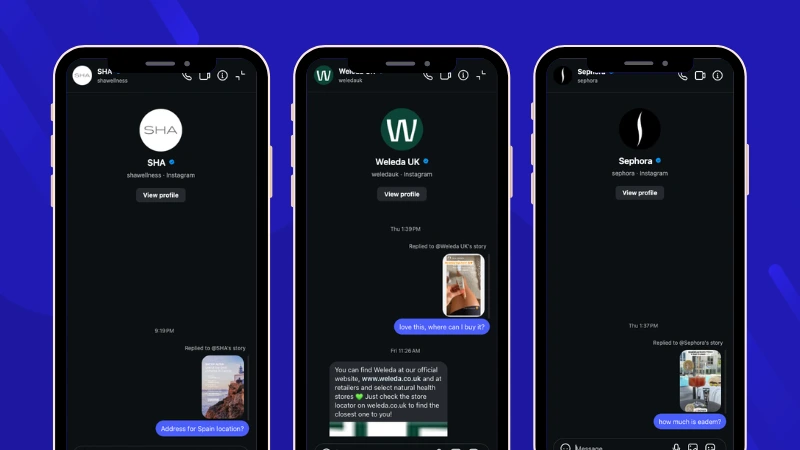
Many DMs are repetitive and predictable. Users ask about:
- Availability
- Delivery
- Pricing
- Campaign rules
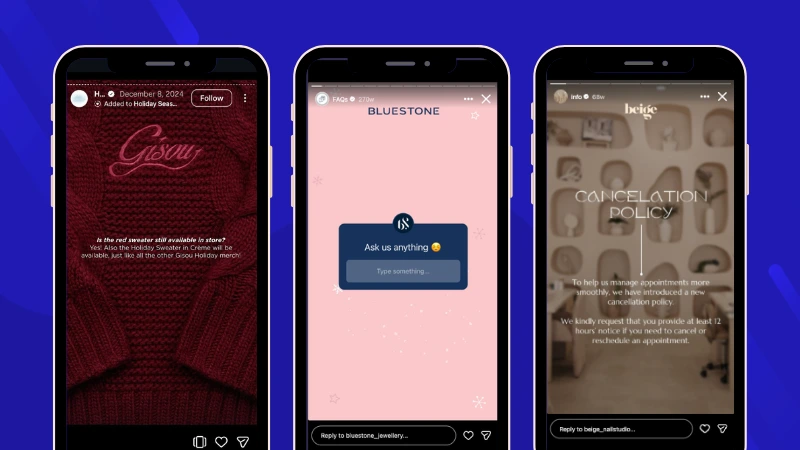
These messages often signal active interest. Sometimes they are part of a buying decision. Other times they relate to a promotion, a coupon, or campaign participation. In all cases, they represent a moment where the user expects a clear and immediate response. The FAQ-style Story examples below illustrate how brands invite these direct questions and turn them into one-to-one conversations in the inbox.
Promotions and Campaigns
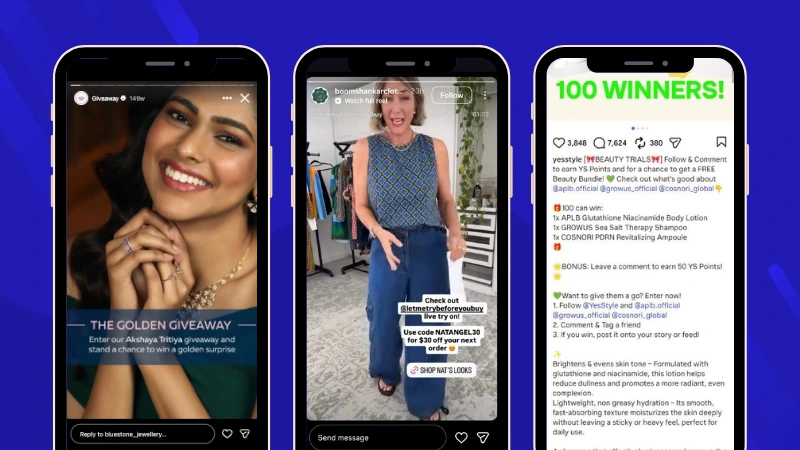
Direct Messages are also central to campaigns. Brands invite users to comment a keyword or reply to a Story to receive:
- A discount code
- Campaign access
- Confirmation of participation
- A downloadable resource
The public interaction creates visibility. The private DM allows the brand to guide the next step in a structured and measurable way. The examples below illustrate how brands use Stories and feed posts to activate these campaigns and move users from public interaction into private conversation.
Ongoing Interaction
The conversation stays in your Instagram inbox, and the user can return to it later. This allows you to respond in context without forcing them to leave the platform.
Across these use cases, one pattern repeats: DMs are tied to specific content and specific interest. How you manage them determines their value.
How Can You Use Instagram DMs More Strategically?
If you want DMs to contribute to business growth, you need structure.
Start with these five steps.
- Analyze the types of messages you receive.
Review your inbox and identify what users are asking. Are the messages related to customer support, pre-purchase clarification, promotions, campaign participation, or follow-ups? Most brands quickly discover recurring themes.
- Measure the time and effort required.
Estimate how much time your team spends answering similar questions. Manual replies may seem manageable, but repetition consumes resources and can slow response times.
- Identify the Most Recurring Questions.
Look for the questions that appear most frequently. Delivery details, pricing, participation rules, or access requests usually follow predictable structures. When the same questions repeat, you can organize them into a clear FAQ framework with predefined answers.
You can then automate these responses using a tool such as Instagram Messaging Automations by Easypromos. This saves time, ensures consistent replies, and improves the user experience while keeping conversations structured. - Automate Messages for Your DM Users and Most Recurring Conversations.
Once you identify your most frequent questions, define how those conversations should unfold. Decide what message should be sent, what information it should include, and what action should follow.
For example, when someone comments a keyword or replies to a Story, you can automatically send a Direct Message with the relevant information. This ensures an immediate response, consistent communication, and a clear next step for the user.
You can automate these structured responses using Instagram Messaging Automations by Easypromos, allowing you to manage high volumes of conversations while maintaining control and quality. - Track outcomes and refine.
Some Direct Messages lead to campaign participation, qualified leads, or sales. If you do not track what happens after the conversation begins, you cannot evaluate the impact of the channel. Structured conversations make measurement possible.
That is the shift from reacting to DMs to using them strategically.
The example below illustrates the types of recurring Direct Messages brands commonly receive, reinforcing why structure and automation become necessary.
Create a free Easypromos account and start a 7-day free trial to test Instagram Messaging Automations and see how automated DM conversations fit into your Instagram strategy.
How Do Instagram DMs Turn Engagement Into Measurable Performance?
Most brands measure Instagram through reach, impressions, likes, and follower growth. However, Instagram DMs for business reveal a different layer of performance. Direct Messages reveal intent. When someone sends you a DM, they are asking, clarifying, or reacting with purpose. The message is often linked to a specific post or Story, which shows what triggered the interaction.
That allows you to ask better questions:
- How many conversations did this post generate?
- Which Stories created the most DMs?
- How many campaign participants came through DM?
When Direct Messages are handled manually, these questions are difficult to answer.
When conversations are intentionally triggered and organized, patterns emerge. Instagram Messaging Automations supports this by linking user actions, such as comments or Story replies, to predefined conversation paths. You can see what triggered the interaction and what happened next.
That is how engagement becomes measurable. Instagram stops being only a visibility channel and becomes a channel where interaction can be connected to outcomes.
Conclusion
Every month, more people choose to message businesses on Instagram instead of interacting publicly. That behavior signals a shift. Users expect direct answers, faster responses, and conversations that move them forward. If you focus only on reach and engagement metrics, you see visibility. When you pay attention to Direct Messages, you see intent. Instagram DMs often connect specific content to specific conversations. They show you what your audience is asking and when they are asking it.
The difference is not whether you receive DMs. It is how you manage them. When conversations are handled without structure, they remain isolated replies. When you manage Instagram DMs for business strategically, they become more than conversations. They become part of your growth strategy.
How to Automate Instagram DMs: Complete Guide to Sending Automatic DMs
FAQs
Instagram Direct Messages, or DMs, are private conversations between a user and a business or creator account within the Instagram platform. They allow one-to-one communication that is not visible publicly.
They serve different purposes. Comments are public and increase visibility. DMs indicate stronger intent because they enable direct and personalized conversation between the user and the brand.
Businesses can use DMs for customer support, sales inquiries, promotion delivery, campaign participation confirmation, and loyalty-building interactions. When structured properly, DMs become a measurable engagement and conversion channel rather than just a messaging tool.
When message volume increases, manual replies become difficult to manage. Businesses can structure and automate recurring conversations using tools such as Instagram Messaging Automations by Easypromos. This allows them to send predefined responses, guide users through specific actions, and maintain consistent communication while saving time.