Executive Summary
What is AI Purchase Receipt Validation with Easypromos?
AI Purchase Receipt Validation refers to a system that automatically reads a photo or PDF of a purchase receipt, interprets every product line, and verifies whether the purchase meets the conditions of an FMCG promotion (products, quantities, combinations, amounts, stores, dates, and more). The system returns an immediate result (valid / not valid) and generates structured data for the brand.
In this guide, you will find everything needed to design and launch an AI Purchase Receipt Validation campaign for FMCG brands.
The guide explains how the system works at a technical level, what types of validations are possible, how to manage promotions when products appear with different names depending on the retailer, how to limit the promotion to specific stores or geographic areas, and how to detect fraud or duplicate purchase receipts. It also details what structured information brands can obtain and how it can be used for analysis, market research, and future strategies. The guide includes real questions and answers raised by brands after validating hundreds of thousands of purchase receipts with AI.
Esta guía está pensada para equipos de marketing y trade marketing de marcas FMCG que quieren diseñar promociones basadas en tickets de compra sin necesidad de desarrollar tecnología a medida.
Note on terminology
Throughout this guide, different terms are used to refer to the same concepts. When referring to AI Purchase Receipt Validation, the guide may also mention receipt validation, automatic receipt reading, purchase receipt verification, or AI-based receipt analysis. Similarly, the transaction document issued by a store at the moment of payment may be referred to as a purchase receipt, receipt, store receipt, or proof of purchase.
General context
FMCG (fast-moving consumer goods) brands have always looked for ways to reward their buyers. However, for many years the options available to prove a real purchase were limited and, in many cases, impractical. Historically, brands have relied on three main approaches:
- Asking users to send the product label by postal mail
- Including a unique code (PIN code) inside the packaging
- Requesting a photo of the purchase receipt and reviewing it manually
Although these methods worked, each of them had significant limitations for both the user and the brand.
Sending product labels by mail resulted in very low participation rates because the effort required from users created a significant barrier to entry. It was also a slow and unattractive process.
Unique codes were expensive for brands to implement, required modifications to the packaging, and in many cases could not be applied to certain products.
Manual purchase receipt validation, although easy for users, completely disrupted the experience. It created long waiting times for receipt approval and required a dedicated human team to review submissions, which increased both costs and delays.
The arrival of OCR technology (Optical Character Recognition) represented an initial step toward automation. For the first time, it became possible to read a receipt quickly and extract basic information such as the total amount, the date, or the store. However, OCR had a clear limitation: it was almost impossible to interpret the receipt at the product line level, identify specific items, or verify detailed promotional conditions.
In 2025, with the consolidation of artificial intelligence and advances in image recognition systems, this situation changed completely. Easypromos achieved what only a few years earlier seemed unattainable: a real-time AI Purchase Receipt Validation system fully integrated with promotional mechanics and automatic prize assignment. It became possible to analyze every product line, apply complex validation rules, and determine immediately whether a receipt meets the campaign requirements.
After validating hundreds of thousands of purchase receipts with artificial intelligence and encountering virtually every possible scenario, the experience and knowledge gained now make it possible to share this guide. The following sections explore in detail how the AI Purchase Receipt Validation system works and answer the most common questions raised by brands in recent months.
How AI Purchase Receipt Validation Works Step by Step
To better understand how validations are applied and how the system determines whether a purchase receipt is valid, here is the full process:
- The user uploads a photo or PDF of the purchase receipt.
The system automatically detects the document and prepares the image for reading.
- The AI extracts all the text from the purchase receipt.
This includes not only the total amount or date, but also every product line, with quantities and prices.
- The system identifies the store, date, amount, and other general elements.
- Anti-fraud checks are applied.
These checks look for duplicates, manipulation, suspicious patterns, or artificially generated images.
- The product lines are analyzed one by one.
This is where the FMCG logic is applied: product detection, product ranges, quantities, combinations, exclusions, specific amounts, and more.
- The campaign rules are applied.
Each line is compared against the dictionaries (TAGS) defined for valid, excluded, or prohibited products.
- The system determines whether the purchase receipt is valid.
The platform checks whether the receipt meets the conditions configured by the promotion administrator.
- The participation is sent to the corresponding promotional mechanic.
Once the system confirms that the receipt meets all the campaign rules, it automatically registers the user’s participation in the configured mechanic, such as a giveaway, Instant Win, Spin the Wheel, points, or direct prizes.
- The full structured data from the purchase receipt is stored.
This information is available in CSV format or via API/Webhook in JSON.
All of this means that the flow is completely automatic: the purchase receipt is validated and sent to the promotion without manual intervention. If the receipt has a valid format but does not meet the participation requirements, the system marks it as pending review for later manual verification.
Proven Technology
Experience Validating Hundreds of Thousands of Purchase Receipts
The Easypromos validation system is neither experimental nor theoretical. It has been tested in real FMCG campaigns across multiple countries, retail chains, and product categories. Hundreds of thousands of purchase receipts have already been processed using AI, making it possible to continuously improve recognition accuracy, anticipate complex scenarios, and refine both validation precision and anti-fraud controls.
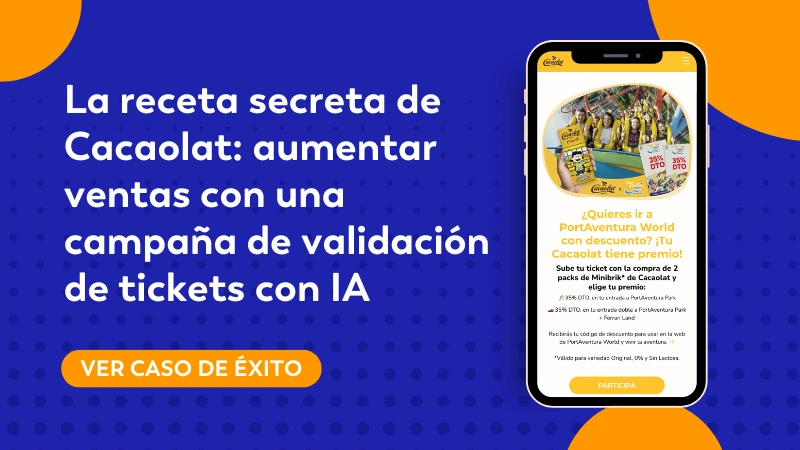 Campaña de validación de tickets de Cacaolat
Frequently Asked Questions About AI Purchase Receipt Validation for FMCG Brands
The following questions and answers address the most common real-world scenarios raised by FMCG brands when designing promotions based on AI Purchase Receipt Validation.
How can a purchase receipt validation promotion work if a brand sells through many channels and every store issues a different type of receipt?
One of the most common questions FMCG brands ask is whether a validation system can interpret receipts as different as those from a large supermarket, a rural gas station, or an independent café. The answer is yes.
The Easypromos receipt validation system is designed to recognize any type of purchase receipt, regardless of its format. It does not require sample receipts from each retailer beforehand, nor does it need specific training for every point of sale. The size of the receipt, the layout of the content, the print quality, or whether it is longer or narrower does not affect the analysis. The AI captures and processes all relevant information automatically.
Thanks to this flexibility, brands can launch national or multi-channel campaigns without worrying about the variability of purchase receipts. The system adapts automatically to different formats and determines in real time whether each receipt meets the promotion’s conditions.
What if a product appears with different names on the purchase receipt depending on the store?
This situation is very common. The same product may appear on a purchase receipt with different descriptions, abbreviations, retailer-specific SKUs, or even typographical errors. This happens especially in national campaigns involving multiple retail chains and points of sale.
To address this scenario, Easypromos uses a product dictionary system, internally referred to as TAGS.
The process works as follows:
- The AI reads the entire purchase receipt line by line.
- Each line is compared with the dictionary configured for that product.
- If a match is found, the campaign validation rules are applied (for example, “minimum 2 units of Product A”).
- If no match is detected, the purchase receipt is sent to manual review to ensure that no valid participation is lost.
The dictionary can include both text descriptions and SKUs. Experience shows that it is best to include as many variations as possible: abbreviations, typical naming formats used by different retailers, and even common typographical errors. This approach ensures that the product can be correctly detected regardless of how it appears on the purchase receipt.
Can a purchase receipt validation promotion be limited to a specific supermarket chain or geographic area?
Yes. Easypromos allows promotions based on AI Purchase Receipt Validation to be restricted by store, retail chain, or geographic location.
The logic is similar to product detection. The AI automatically identifies the store name, address, and city from the purchase receipt. Based on this information, it is possible to configure customized dictionaries that define which stores or locations are valid for participation.
For example, a promotion could be created exclusively for Supermarket Chain XYZ and limited to stores located in Valencia, Barcelona, and Madrid. Only purchase receipts issued by those stores in those cities would be accepted in the campaign.
What happens if a product reference is unknown in a particular supermarket? Will the system reject the purchase receipt?
No. This is precisely the type of situation handled by the Easypromos pre-moderation system.
When the system detects that a purchase receipt does not meet the product conditions because the dictionary (TAGS) is incomplete, because the product appears with an unexpected description, or because the receipt is not fully readable, it does not automatically reject it. Instead, the receipt is marked as “pending review” so your team can verify it manually.
From the pre-moderation panel, it is possible to:
- View the image of the purchase receipt and all the data extracted by the AI
- Check whether the product actually corresponds to the correct reference, even if it was not recognized by the TAGS (for example due to a different abbreviation, an alternative name, or a retailer-specific SKU)
- Decide whether to approve or reject the receipt on a case-by-case basis
This manual review process also has a positive long-term effect. Each time a new way of describing the product appears on a receipt, the TAGS dictionary can be expanded to include that variation. Over time, the system learns to recognize these additional formats automatically, reducing the need for manual intervention in future participations.
AI can make mistakes. Can purchase receipts be reviewed manually?
Yes. Always.
In Easypromos, AI Purchase Receipt Validation can be configured in two different modes:
- Mandatory pre-moderation (manual mode)
All purchase receipts are reviewed by a person before they are accepted.
This mode is ideal when launching a campaign for the first time, when products appear with many variations depending on the retailer, or when you want full control while optimizing the TAGS dictionaries. - Automatic validation with review only for doubtful cases
Once the system is properly configured and the dictionaries are solid, automatic validation can be activated as follows:
- Valid purchase receipts are automatically accepted and sent to the promotion without human intervention.
- Only ambiguous cases are marked as “pending review”.
This hybrid approach provides the best balance between automation and control. Valid purchase receipts are not lost, while the promotion benefits from the speed and efficiency of a fully automated system.
My products are sold in physical stores and on Amazon, but I only want purchase receipts from physical stores to qualify for the promotion. What can I do?
This situation is very common in campaigns where a brand wants to reward purchases made only through physical retail channels, excluding online platforms such as Amazon. To manage this, Easypromos uses the same dictionary system (TAGS) used to detect valid products or stores, but applied in the opposite way through prohibited tags.
How does it work?
- The AI reads the entire purchase receipt or invoice, including the header, the store name, the address, and any references to the sales channel.
- During validation, the system compares this information with a list of prohibited tags configured for the campaign.
- If the receipt contains any of these tags, such as “Amazon,” “Amazon EU,” “Marketplace,” “AMZ,” or other common variations, the system automatically applies the rule defined for the campaign. The receipt is marked as not valid for the promotion.
- Receipts from physical stores such as supermarkets, hypermarkets, gas stations, cafés, or other brick-and-mortar retailers follow the normal validation flow and can participate without any issues.
It is important to understand that prohibited tags work in the same way as product or store dictionaries, but with an exclusion logic.
This same mechanism can also be used to exclude specific products or geographic locations from a campaign.
How does the system handle very long purchase receipts? Is there a reading limit?
There is no problem. Easypromos can process purchase receipts of any length, whether the user uploads a photo or a PDF. The system regularly processes receipts from supermarkets, hypermarkets, and other retail establishments where the list of items can be particularly long.
From a technical perspective, very long receipts present a known challenge in the industry often referred to as “AI fatigue.” Some models tend to lose accuracy as the number of lines increases. To address this, Easypromos has developed an optimized processing flow for long receipts, which adjusts the reading and analysis based on the length of the document. There is no need to split the receipt or ask the user to photograph it in multiple parts.
Thanks to this internal optimization:
- There is no length limit for receipts.
- Reading accuracy remains the same for short, medium, and very long receipts.
- Data extraction stays consistent regardless of the format or size of the document.
In short, the system is designed to process purchase receipts of any size, without loss of accuracy and without requiring any additional action from the user.
How does the system prevent duplicate, manipulated, or AI-generated purchase receipts?
The AI Purchase Receipt Validation system in Easypromos includes multiple security layers designed to detect attempts at fraud, duplication, or image manipulation. This is a common concern in purchase-based promotions, which is why specific controls are in place to identify suspicious behavior from the start.
- Duplicate detection (same image and repeated receipt)
The system does not allow the same image file to be uploaded more than once. Beyond checking the file itself, the platform also verifies that the receipt is unique by analyzing the combination of store, date, time, total amount, and promotion. If the system detects the same receipt submitted again in a different photo, for example two pictures of the same receipt, it is automatically rejected. - Detection of receipt manipulation or editing
The AI also evaluates whether the receipt shows signs of alteration. If manipulation is detected, the receipt is rejected. Examples include:- Handwritten text added to the receipt
- Digitally overwritten information
- Unusual cuts or cropping
- Added visual elements
- Any indication of unnatural image editing
- Detection of artificially generated purchase receipts (AI-generated images)
The system also includes additional verification layers designed to identify non-authentic or AI-generated receipt images. Just as it is possible to counterfeit a banknote, it is also possible to attempt to falsify a purchase receipt. The Easypromos technology is optimized to detect anomalous patterns and suspicious image characteristics that may indicate artificial generation or manipulation.
For obvious reasons, these mechanisms are not described in detail, as doing so could provide guidance to malicious users. What can be confirmed is that detection models are continuously improved based on thousands of receipts processed and on new real-world cases encountered in promotions. - Fraud prevention is not only about technology. It is also about promotion design.
The most effective way to reduce fraud is not only to detect fake receipts, but also to design promotions in a way that discourages fraudulent behavior.
If the incentive is too high or the participation mechanic is too easy to exploit, the risk of fraud increases. For that reason, it is recommended to design promotions where the value of the prize, participation frequency, and validation conditions make the effort required to falsify a receipt not worthwhile.
This topic is explained in more detail in the article How to Avoid Promotional Mechanics That Encourage Cheating.
What information can be obtained from participating purchase receipts?
AI Purchase Receipt Validation does more than confirm whether a receipt meets the promotion’s conditions. It also converts the entire receipt into structured data. For each validated receipt, the brand obtains:
- Store information (name, address, city)
- Purchase date and time
- Total purchase amount
- All product lines, including description, quantity, price, and line total
All this information can be downloaded in CSV format or received via API/Webhook in JSON format, ready to be integrated into internal systems, dashboards, or analytics tools.
With this data, brands can:
- Analyze real purchasing behavior: which of their products are purchased, in what combinations with other products, how frequently, in which stores, in which geographic areas, and at what prices. This includes insights not only about the promoted products but also about the rest of the shopping basket.
- Obtain and understand consumer behavior patterns: spending habits, brand mix, the impact of promotions, and potential recurring purchase behaviors.
- Design future marketing, product, and assortment strategies based on real purchase data, rather than estimates or external panel data.
In other words, a promotion based on purchase receipt validation becomes more than a sales activation. It becomes a valuable data source for market research, commercial intelligence, and analysis of real consumer purchasing behavior.
What types of validations can be applied in FMCG campaigns?
In FMCG (fast-moving consumer goods) promotions, beyond general purchase receipt validations such as purchase date, total amount, or store, the key capability lies in line-by-line receipt analysis. This is where AI makes the difference, because it allows the system to analyze exactly which products were purchased, in what quantity, and how they appear on each retailer’s receipt.
The most common validations used in FMCG campaigns include:
- Validation by specific product
The AI can identify a specific product regardless of how it appears on the receipt: abbreviations, alternative descriptions, retailer SKUs, or even typographical errors. Typical campaign examples include:- “Buy Product A.”
- “Participate when you purchase any item from our product range.”
- Validation by minimum quantity
This validation requires a minimum number of units of the same product or of a product range. Examples include:- “Buy 2 units of Product A.”
- Buy 3 products from the brand.”
- Validation by product range or product family
A group of product references can be defined, allowing any combination of them.
Example: “Buy any variant from our yogurt range.” - Validation by product combination (purchase mix)
The AI can detect specific combinations of products within the receipt. Examples:- “Buy 2 beers + 1 snack.”
- “Buy 1 shampoo + 1 conditioner.”
- “Buy one beverage and one complementary product.”
- Validation by complementary or cross-category products
This validation allows participation when purchases include related products. Examples include:- “Participate when you buy a detergent pack + fabric softener.”
- “Buy a product from Brand A together with a product from Brand B.”
- Validation by product exclusion
In some FMCG campaigns, certain products must be excluded. If the AI detects any excluded products, the purchase receipt is automatically rejected. Examples include:- Products from competing brands
- Non-promoted product formats
- Validation by line amount
The AI can verify the total amount spent on a brand’s products or on a specific subset of product lines. This validation is especially useful in multi-product campaigns or broad product ranges. Examples include:- “Spend at least €5 on products from our brand.”
- “Spend at least €10 on any combination from range X.”
- “Spend €15 across several different product references.”
How can participants who upload a valid purchase receipt be rewarded?
The AI Purchase Receipt Validation system in Easypromos has two key advantages. First, it can analyze and process any type of purchase receipt. Second, it integrates directly with all Easypromos promotional mechanics and the prize distribution system.
Once the system automatically confirms that a receipt is valid, there are several ways to reward participants.
Random prize drawing
All users who upload a valid purchase receipt participate in a final prize drawing for a grand prize. In this scenario, it is possible to:
- Users receive extra entries based on the number of receipts submitted.
- Users receive extra entries based on the amount spent on one or several receipts.
- Users receive extra entries based on the amount spent on a specific product across one or more receipts.
Instant Prizes
After the purchase receipt is validated, the participant can receive a direct reward, such as:
- A coupon linked to the store where the purchase was made
- A coupon linked to the product purchased and its purchase amount
- Discounts or physical rewards based on the number of units purchased for one or more specific products
Cashback
After the receipt is validated with AI, the system confirms the purchase and allows a full or partial refund to be applied automatically. The most common models include:
- Fixed cashback per product. For example: “Get €1 back for each unit of Product A.”
- Percentage cashback. For example: “Receive 25% of your purchase value back.”
- Minimum spend cashback. For example: “Spend €10 on our product range and receive €3 back.”
- First-purchase cashback. This is useful for acquiring new consumers or encouraging trial of a new product.
Using the Easypromos prize distribution system, refunds can be delivered through different methods:
- Integrated external payment platforms
- Delivery of a coupon with equivalent value
- If the promotion is integrated into a loyalty app, the refund can be credited to the user’s digital wallet or promotional balance within the app.
Points or virtual coins
Easypromos includes its own virtual coins system, which can operate independently or be integrated with the coins/points system of an existing loyalty app. After the purchase receipt is validated, the promotion can award:
- X coins for every Y euros spent on the total purchase amount
- X coins for every Y units purchased, or for every Y euros spent on a specific product
Prize Wheel spins or Scratch & Win attempts
This is one of the most commonly used models in FMCG promotions because it combines verified purchases with immediate gamification.
Once the purchase receipt has been automatically validated, the system can assign:
- Spins on a prize wheel
- Attempts in a digital Scratch & Win game
The conditions for earning these spins or attempts can be configured with full flexibility. For example:
- For every X euros/dollars spent in total, users get Y prize wheel spins.
- For every X euros/dollars spent on a specific product, users get Y Scratch & Win attempts.
How can users access a promotion based on AI Purchase Receipt Validation?
Every Easypromos promotion is essentially a web page where a participation mechanic and prize distribution rules have been defined. In the case of a promotion based on AI Purchase Receipt Validation, the promotion will typically include at least:
- A mechanism to identify the participant
- A screen where the participant can upload the purchase receipt
- A receipt verification flow
- A screen displaying the verification result and the associated outcome
The question then becomes: how do users reach these screens?
There are several possible access methods, and the best option depends on the brand’s strategy, the sales channel, the target audience, and the organizer’s technological infrastructure. The main options are explained below.
1. Standalone microsite (promotional landing page)
This is the most common format in FMCG campaigns. The promotion is presented on a dedicated microsite with its own URL (either a domain or subdomain of the brand). Access to the microsite can be promoted through:
- QR codes on packaging or on the supermarket shelf
- Digital advertising (Meta ads, display, video, search)
- Social media
- Newsletter campaigns
- Printed materials at the point of sale
An interesting feature of this access method is that the microsite can function as a Progressive Web App (PWA). When a user participates for the first time, the system asks whether they would like to add a shortcut to their mobile device. If the user accepts, an icon with the promotion’s name appears on their phone, similar to an app downloaded from an app store. Having the promotion icon on the user’s device offers two major advantages:
- The promotion is always easily accessible, without needing to remember a URL or scan a QR code again.
- Login remains persistent, meaning the user does not need to login each time they participate, just like with any mobile app.
The combination of microsite + PWA works especially well for promotions where users participate multiple times over an extended period.
2. Promotion embedded on the brand’s website
The promotion can also be displayed directly within the brand’s website. This is done using Easypromos widgets, a small code snippet that can be embedded in any section of the site, allowing the promotion to appear integrated within the web page without redirects.
This format is particularly useful when the goal is to centralize traffic on the corporate website or when the site already receives a significant amount of organic or paid traffic.
By adapting colors and background design, the promotion can be fully aligned with the website’s visual identity, creating a consistent and seamless experience for the user.
3. Integration within a brand or retailer loyalty app
If the brand or supermarket chain has a loyalty app, the promotion can be integrated as a specific section within the app.
Integration with a loyalty app involves three key elements:
- User system integration. Thanks to the Easypromos SSO (Single Sign-On) Autologin solution, users of the app are automatically identified within the promotion without needing to log in or register again.
- Screen customization. The promotion appears within the app’s interface using the same design and visual style as the app itself. Users will not perceive that they are interacting with a third-party application.
- Data synchronization. All data generated in the promotion can be synchronized via API with the app’s data, including the balance of coins or points.
This format makes it possible to:
- Accumulate points or balance in the app’s wallet
- Track receipt uploads and participation history
- Offer exclusive benefits to registered users
- Keep the consumer within the brand’s digital ecosystem
Can AI Purchase Receipt Validation be used with social media?
Purchase receipts cannot be uploaded directly within a social media platform. For this reason, social media is typically used to promote the campaign and drive traffic to the promotion page. Common approaches include:
- Posts announcing the promotion
- Links in the bio or profile
- Stories with link stickers
- Sponsored posts
In purchase receipt validation campaigns, success does not depend only on the access format. It also depends on how effectively the promotion is communicated. The key is to amplify the campaign across multiple channels, such as:
- Product packaging
- Point of sale materials
- Loyalty app
- Social media
- Digital advertising
- CRM channels (email, SMS, push notifications)
- Retailer activations
The more channels that are activated, the greater the participation and number of validated purchase receipts.
What resources does a brand need to manage a purchase receipt validation promotion?
Although the AI validation system correctly processes around 98% of purchase receipts without human intervention, a small percentage will always require manual review. This is not a limitation of the system but rather a consequence of the huge variety of receipt formats that exist: different layouts, unusual product descriptions, unexpected SKUs, or retailer-specific variations.
For this reason, especially during the first week of the promotion, it is recommended that the brand assigns one person or a small team to review receipts marked as “pending review”. This task is important because it allows the team to:
- Quickly detect products or SKUs that were not included in the initial dictionaries (TAGS)
- Identify description variations specific to certain retailers or regions
- Correct minor configuration issues (incomplete tags, missing abbreviations, unexpected naming formats)
- Adjust and optimize the dictionaries so the system improves its recognition accuracy in real time
In national or multi-channel campaigns, where the variety of receipts can be extremely high, this initial review phase becomes even more important. Experience shows that after a few days of adjustments, the validation flow stabilizes and the percentage of receipts pending review decreases significantly. At that point, the campaign can operate almost entirely autonomously.
In short, AI manages the vast majority of validations, but a small amount of human oversight at the beginning of the campaign ensures maximum accuracy across all retailers, channels, and receipt formats.
What are the main use cases for FMCG campaigns based on purchase receipt validation?
Automatic AI Purchase Receipt Validation enables a wide variety of campaign types for FMCG (fast-moving consumer goods) brands. The most common use cases include:
- Minimum purchase or volume campaigns
Example: “Buy 2 units and participate.” - Multi-product or multi-format promotions
Ideal for product ranges that include different sizes, flavors, or variations. - Complementary product combinations
Examples: “snack + beverage,” “shampoo + conditioner,” or “detergent + complementary product.” - Retailer-specific or regional campaigns
Promotions that are only valid in a specific retail chain or in certain geographic areas. - Receipt-based loyalty programs
Participants accumulate points based on the value or quantity of products purchased.
These use cases cover most of the typical promotional mechanics used in the FMCG sector and allow campaigns to be adapted to different commercial objectives, such as:
- Increasing purchase frequency
- Driving sales of a specific product range
- Encouraging cross-selling between complementary products
- Generating repeat purchases and long-term loyalty.
How does Easypromos manage purchase receipt and user data in FMCG campaigns under GDPR?
In FMCG campaigns based on AI Purchase Receipt Validation, data is processed exclusively to verify the purchase and apply the promotional rules configured by the brand. This includes the structured reading of product lines, amounts, store information, purchase date, and other data contained in the purchase receipt.
Under the General Data Protection Regulation (GDPR):
- Easypromos acts as the data processor, processing the data on behalf of the organizing brand.
- The brand acts as the data controller, and only the brand can access the exported information (CSV or via API/Webhook).
- Data is securely stored and is blocked or deleted once the promotion ends, according to the retention periods defined by the brand.
- Users may exercise their data protection rights at any time, including the rights of access, rectification, erasure, objection, restriction, and data portability.
For full details, please refer to our privacy policy.
Conclusion: Checklist to Prepare Your FMCG Campaign with AI Purchase Receipt Validation
Before launching a promotion, make sure the following elements are clearly defined:
- Campaign objective (sales, volume, product mix, loyalty, etc.)
- Products or product ranges included in the promotion
- Minimum quantities or required product combinations
- Valid stores, retail chains, or geographic areas
- Channels to exclude, if necessary (Amazon, marketplaces, online stores, etc.)
- Initial product dictionaries (TAGS) and their common variations
- Type of reward (prize draw, instant win, virtual coins, cashback, gamified mechanics)
- Data management for the campaign, including participant information and purchase receipt data
With these elements clearly defined, all the necessary components will be in place to launch a robust and automated AI Purchase Receipt Validation campaign.
Want to see how it works in your next promotion?
If you are considering launching an FMCG campaign with AI Purchase Receipt Validation, you can register on our website and create a promotion to test everything you need. Registration on Easypromos is free. A license is only required when you are ready to launch the promotion publicly. You can find more information here:
AI Purchase Receipt Validation: demos and examples
Tutorial: How to Validate Purchase Receipts
If you prefer, you can also contact the Easypromos team and we will organize a personalized session for your brand or agency.