A live broadcast can play two important roles in a giveaway campaign. It can encourage viewers to participate through tools such as on-screen QR codes, and it can become the stage for announcing the giveaway winner in a transparent and engaging way. Together, these two moments transform the broadcast from a communication channel into an integral part of the giveaway experience.
High-profile campaigns, whether television programs, charity telethons, corporate events, social media livestreams, or promotions involving large communities, require a giveaway winner announcement that combines three essential elements: audience engagement, operational reliability, and verifiable transparency.
With Easypromos, brands can select winners at random from registered participants, generate a public Certificate of Validity, and present the winner announcement using a customizable countdown video. This transforms the winner announcement into an engaging live moment while ensuring the entire process remains controlled, impartial, and fully traceable. See how Colombian furniture and home furnishings retailer Muebles Jamar used a live broadcast to announce the winners of three car giveaways held as part of its anniversary campaign:
Before the Live Broadcast: Plan How Participants Will Enter the Giveaway
Although the audience only sees the live broadcast, much of the work behind a successful giveaway winner announcement happens beforehand. A giveaway held during a live broadcast does not begin when the host announces the winner. It starts much earlier, when the brand defines who can participate, what information it needs to collect, how the campaign will be explained to the audience, and what value that audience can provide after the broadcast.
For marketing and communications teams, this stage is essential. A live broadcast attracts attention, but that attention only becomes valuable when there is a clear way to turn viewers into registered participants.
One of the simplest ways to achieve this is by displaying a QR code during the broadcast. It can appear on the main screen, in a side banner, as part of an on-screen graphic, or at specific moments in the script. When viewers scan the code, they access an online participation experience where they can register, accept the Terms and Conditions, and enter the giveaway.
TV Campaign Example Using a QR Code: The Most Beautiful Town in Castilla-La Mancha
The television program The Most Beautiful Town in Castilla-La Mancha displayed a QR code on screen to make it easier for viewers to participate. Residents of the different towns could vote for their community by simply scanning the code with their mobile devices.
Although this campaign used online voting rather than a giveaway, it clearly illustrates how a QR code can be incorporated into a live broadcast to direct viewers to an online participation experience.
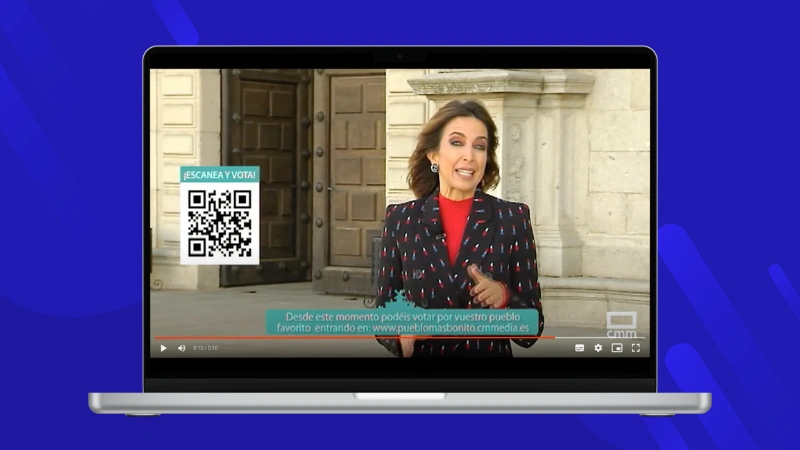
A QR code transforms the attention generated by a live broadcast into measurable participant engagement. The brand does more than gain visibility. It can also capture leads, segment participants, activate follow-up communications, and measure campaign performance.
This planning is especially important for charity telethons, high-audience events, and campaigns offering high-value prizes. Viewers should clearly understand how to participate, how long entry remains open, and which conditions apply. The clearer the participation mechanic, the lower the risk of confusion, complaints, or a sense that the process is being improvised.
TV Campaign Example Using a QR Code: Un Sol para los Chicos by UNICEF Argentina
Another example of using QR codes during a television broadcast is Un Sol para los Chicos, an annual fundraising telethon broadcast by El Trece TV in Argentina. Each year, the program brings together brands, sponsors, and viewers to raise funds for UNICEF’s projects across the country.
During the live broadcast, viewers can scan an on-screen QR code to make a donation and support the initiative. Everyone who donates is added to a participant list and automatically entered into a random giveaway for a high-value prize donated by one of the campaign’s sponsoring brands. In this way, the live broadcast becomes both the entry point to the giveaway and the setting for announcing the winner.
This campaign demonstrates how a live broadcast can combine fundraising, participant registration, and a transparent giveaway, all through a simple on-screen QR code.
In campaigns like this, transparency is especially important. Not only because the prize has significant value, but also because the campaign supports a charitable cause and is associated with a highly visible organization. Viewers need to feel confident that the process is clear, every participant has an equal chance of winning, and the giveaway winner is selected through a random and verifiable process.
To reinforce that trust, the broadcast combines several credibility elements: the presence of a public notary during the winner announcement, a clear explanation of the selection process, and the use of Easypromos to conduct the random draw. This allows the live broadcast to maintain its natural pace while relying on a digital platform that provides reliability, traceability, and verifiable transparency throughout the giveaway process.
This example demonstrates how a giveaway during a live broadcast can be integrated into a high-profile campaign without compromising control or transparency. QR codes make it easy for viewers to participate, the platform centralizes participant registration, and the random draw is carried out using a certified random selection system. At the same time, the live winner announcement reinforces audience confidence by showing that the result is fair, transparent, and independently verifiable.
A giveaway QR code is more than just an entry point. It transforms a live broadcast audience into a registered, measurable participant database.
During the Live Broadcast: Build Anticipation Without Losing Control of the Outcome
Once participation has closed and the random draw has been completed, the focus of the live broadcast shifts to presenting the result. The winner announcement is the emotional high point of the broadcast. If it happens too quickly, much of the anticipation is lost. If it drags on unnecessarily, viewers may become impatient or begin to question the outcome. And if the process is not clearly explained, the audience may start to doubt the fairness of the random draw.
For that reason, the winner announcement should be planned as a dedicated segment of the live broadcast.
The presenter should know exactly what will happen, what needs to be explained, and how much time is available. The production team should have all on-screen graphics, supporting visuals, and presentation assets ready in advance. At the same time, the brand should ensure that the giveaway results are presented clearly, consistently, and in accordance with the campaign’s Terms and Conditions.
This is particularly important in public voting campaigns, community initiatives, or promotions involving highly engaged audiences. When the outcome carries significance for participants, supporters, or fans, the live broadcast does more than announce a winner. It demonstrates the integrity of the entire giveaway process. The way the results are presented should strengthen audience confidence and reinforce the perception that the random draw was conducted fairly and transparently.
Example of a Giveaway During a Live Broadcast: The Most Beautiful Town in Castilla-La Mancha
The Most Beautiful Town in Castilla-La Mancha campaign, introduced earlier in this article, also demonstrates how to conduct a giveaway during a live broadcast in a transparent and engaging way.
The program highlights the importance of treating the giveaway winner announcement as a central moment of the broadcast. Every element, from the production and pacing to the on-screen presentation, was carefully planned to build anticipation and turn the announcement of the results into a memorable experience for the participating communities.
Explore this public voting campaign and discover ideas for your next giveaway during a live broadcast.
During the Live Broadcast: Present the Giveaway Winner with a Customized Video
A best practice is to separate the random draw from the winner reveal. First, the winner is selected using a random and verifiable system. Then, the result is revealed visually through a countdown, sound effects, and graphics that match the branding of the program or campaign.
Using Easypromos, brands can create a customized winner announcement video specifically designed for live broadcasts. The video includes a countdown and visual effects that build anticipation before revealing the winner. It can be downloaded as an MP4 file or shared via a URL, making it easy to use in a television studio, on a large event screen, across social media, or during an online live broadcast.
This approach offers two key advantages. First, it preserves the pace of the live broadcast and transforms announcing the winner into a more engaging moment for the audience. Second, it reduces technical pressure on the production team because the winner is presented through a pre-generated, controlled media asset.
The countdown creates the excitement of a television moment. The real confidence comes from knowing that the winner was selected through a certified random system, that the entire process is recorded, and that the brand can provide a public Certificate of Validity as proof of the result.
A giveaway during a live broadcast can be used across many types of campaigns, from retail promotions and product launches to fundraising events and community initiatives. Whether organized by a furniture retailer, a consumer brand, or a nonprofit organization, the giveaway helps drive participation, strengthen audience engagement, and create a memorable experience before, during, and after the broadcast.
Example of a Giveaway During a Live Broadcast Using a Customized Winner Announcement Video: Muebles Jamar
As you saw in the video at the beginning of this article, Muebles Jamar, the Colombian furniture and home furnishings retailer, celebrated its 75th anniversary by giving away several cars using Easypromos’ random giveaway system. The winner announcements were broadcast live on Instagram, transforming the moment of revealing the winner into a high-visibility brand experience.
During the live broadcast, the team explained the giveaway rules and reminded viewers of the eligibility requirements participants had to meet to qualify for the prize. This is particularly important in high-value giveaways because announcing the winner should involve more than simply displaying a name. It should also demonstrate that the result has been obtained according to the campaign’s predefined Terms and Conditions.
To present the result, the brand created a customized winner announcement video using Easypromos. The video featured a countdown designed to build anticipation before revealing the winner. This format helps maintain the excitement of the live broadcast while turning the winner announcement into a more engaging moment for the audience, without compromising control of the giveaway process.
In addition to the main winner, eight alternate winners were selected. This provides an added layer of security if the original winner does not respond, declines the prize, or fails to meet any of the eligibility requirements set out in the Terms and Conditions. Before awarding the prize, the team also verified that the selected winner fully complied with the participation requirements.
The Muebles Jamar campaign demonstrates how a brand can present a high-value giveaway during a live broadcast by combining audience engagement, transparency, and operational control. While the live broadcast builds anticipation and captures viewers’ attention, Easypromos provides the certified random winner selection, the ability to designate alternate winners, and the tools needed to document and validate the outcome.
How to Demonstrate That a Giveaway Was Conducted Fairly
In a giveaway, transparency should not rely on a verbal explanation or the audience’s trust in the presenter. The brand should be able to demonstrate that the winner was selected through a fair and impartial random draw, that all eligible participants met the campaign requirements, and that the outcome was not manipulated.
This is particularly important for legal teams, communications departments, and brands with a high public profile. When a giveaway is conducted before a large audience, any uncertainty can quickly spread across social media, through comments during the live broadcast, or in questions raised by participants afterwards.
For this reason, it is good practice to prepare three key elements before the live broadcast.
- Clear Terms and Conditions. They should explain who is eligible to participate, the participation period, how the winner will be selected, what happens if the winner does not respond or fails to meet the eligibility requirements, and how alternate winners will be managed.
- A finalized and validated participant database. The team should know exactly which participants are included in the random draw, which eligibility criteria have been applied, and which entries have been excluded for failing to meet the campaign requirements.
- Publicly verifiable proof of the result. This is where the Certificate of Validity plays a central role.
Transparency and Legal Validation for Your Audience
When a giveaway winner is announced during a live broadcast, transparency depends on more than simply displaying the result on screen. The audience should understand that the winner is selected through a random system, that the process follows predefined rules, and that the brand can demonstrate the validity of the outcome.
For this reason, it is important to use a trusted platform to conduct the random draw. Easypromos enables brands to select winners impartially and complies with the international GLI-19 standard for random number generation systems. This certification provides an additional level of assurance for high-value giveaways, high-profile campaigns, and promotions where audience trust is especially important. Learn more about Easypromos’ security certifications.
In live winner announcements, this technological assurance can be further reinforced by the presence of a notary public or a member of the organization’s legal team. Their role is to publicly verify that the random draw is conducted according to the campaign’s Terms and Conditions and that the process is carried out transparently before the audience.
This approach can be clearly seen in the UNICEF Argentina and Muebles Jamar examples featured earlier in this article. In both cases, the audience is informed during the live broadcast that the winner is selected using a random draw platform. In the Muebles Jamar campaign, the process is explained in greater detail, further reinforcing confidence in the fairness of the draw and compliance with the campaign rules.
The Easypromos Certificate of Validity provides an additional layer of transparency by documenting the outcome of the random draw and creating a public record that can be shared with participants. The certificate confirms that the winner was selected fairly and impartially and that the result has been officially recorded. Once the random draw has been completed, the outcome cannot be modified, further strengthening the traceability of the process.
During the live broadcast, the presenter can explain the process in simple terms:
“We’re about to conduct the random draw using Easypromos, a digital engagement platform that allows us to select the winner fairly and generate a Certificate of Validity to document the result.”
This explanation avoids unnecessary technical detail while communicating the key message: the winner is not selected manually, the random draw is carried out using a certified platform, and the brand can demonstrate the validity of the outcome after the live broadcast.
For legal teams, using Easypromos and the Certificate of Validity does not replace well-drafted Terms and Conditions or appropriate legal review before launching the campaign. However, they provide an additional layer of reliability, traceability, and transparency, helping brands communicate the giveaway results with confidence.
Managing Unexpected Issues During a Live Broadcast
In a live broadcast, the greatest risk is not always the giveaway itself. More often, it comes from what happens around the winner announcement: a phone call that does not go through, a winner who does not answer, a screen that takes too long to load, a presenter who is unsure how to proceed, or an unexpected reaction from the audience.
For this reason, brands should prepare a contingency plan before going live. The goal is not to anticipate every possible scenario, but to decide in advance how the team will respond to the situations most likely to affect the broadcast.
One of the most common situations is when the winner does not answer the phone during the live broadcast. In this case, the Terms and Conditions should clearly explain what happens next: how many contact attempts will be made, how long the winner has to respond, whether an alternate winner will be contacted, or whether the original winner retains the right to claim the prize after the broadcast. For example, in the Muebles Jamar campaign, both the winners and the eight alternate winners were displayed for each giveaway, ranked according to the outcome of the random draw.
Another possible situation is that the selected winner does not meet the eligibility requirements. For example, they may not have completed the registration form correctly, may not reside in an eligible region, may already have received another incompatible prize, or may be unable to provide proof of a required qualification. In these cases, having alternate winners and clearly defined rules helps avoid improvised decisions.
Technical issues can also occur. An internet connection may fail, a screen may not load correctly, or there may be a delay before the result can be displayed. To prevent these situations from undermining audience confidence, it is advisable to prepare supporting resources in advance, such as a contingency message for the presenter, an alternative presentation screen, a verified backup connection, and the winner announcement video ready to play.
The objective is not to hide an issue, but to handle it calmly and professionally. When the rules have been clearly defined and the production team knows how to respond, an unexpected situation does not have to become a reputational crisis.
For example, the presenter could say:
“We’ll now follow the procedure established in the Terms and Conditions. If we’re unable to reach the winner at this time, we’ll activate the alternate winner process and communicate the final outcome through the brand’s official channels.”
This type of message conveys control, avoids unnecessary improvisation, and reinforces confidence in the fairness of the giveaway.
In high-profile giveaways, a brand’s reputation depends as much on how unexpected situations are managed as on the outcome itself. That’s why the best crisis management strategy is to have the rules and procedures agreed upon before the live broadcast begins.
Checklist for Successfully Running a Giveaway During a Live Broadcast with Confidence
A giveaway during a live broadcast works best when every team involved, including marketing, communications, legal, production, customer support, and the presenter, follows the same process. This checklist covers the key points to review before, during, and after the broadcast.
Before the Live Broadcast
- Publish the Terms and Conditions, define the eligibility requirements, and establish what will happen if the winner does not respond or fails to meet the requirements.
- Prepare the participation page, registration form, QR code, and visual assets that will appear during the broadcast.
- Review the presenter’s script and confirm with the legal team how the giveaway process will be explained.
- Define the alternate winner procedure and the contingency plan for technical issues or questions about the result.
During the Live Broadcast: Audience Participation
- Display the QR code on screen and clearly explain how to participate, when the participation period closes, and which conditions apply.
- Make sure the participation mechanic remains consistent with the Terms and Conditions, and remind viewers that the winner will be selected at random from all valid participants.
Shortly Before Announcing the Winner
- Close participation, validate the participant database, and conduct the random draw using Easypromos.
- Select the winner and the required number of alternate winners, then generate a customized winner announcement video with a countdown for use during the broadcast.
- Announce the winner during the live broadcast and contact them according to the predefined protocol.
- Play the countdown video to build anticipation and present the result clearly.
- Explain that the winner was selected through a random draw with appropriate transparency safeguards.
- If the winner must be validated before receiving the prize, explain that the team will verify compliance with the eligibility requirements.
After the Live Broadcast
- Publish the winner through the brand’s official channels and share the giveaway’s Certificate of Validity.
- Contact the winner if this was not done during the broadcast, and activate the alternate winner procedure when necessary. Keep a record of the process and supporting evidence.
- Repurpose the winner announcement video and analyze participation, lead generation, and conversion results.
Conclusion
Successfully running a giveaway during a live broadcast requires much more than selecting a winner. The brand needs to collect entries through a clear and organized process, create an engaging moment for the audience, and demonstrate that the outcome was reached fairly and transparently.
When the giveaway is carefully planned, the live broadcast flows more smoothly, the audience understands the process, and the brand protects its reputation. When a certified random draw system and a Certificate of Validity are also used, the result no longer depends on audience perception alone. It becomes a verifiable record that can be shared with participants.
With Easypromos, brands can conduct impartial random draws, generate a public Certificate of Validity, and create customized winner announcement videos that help present results with greater impact, anticipation, and confidence.